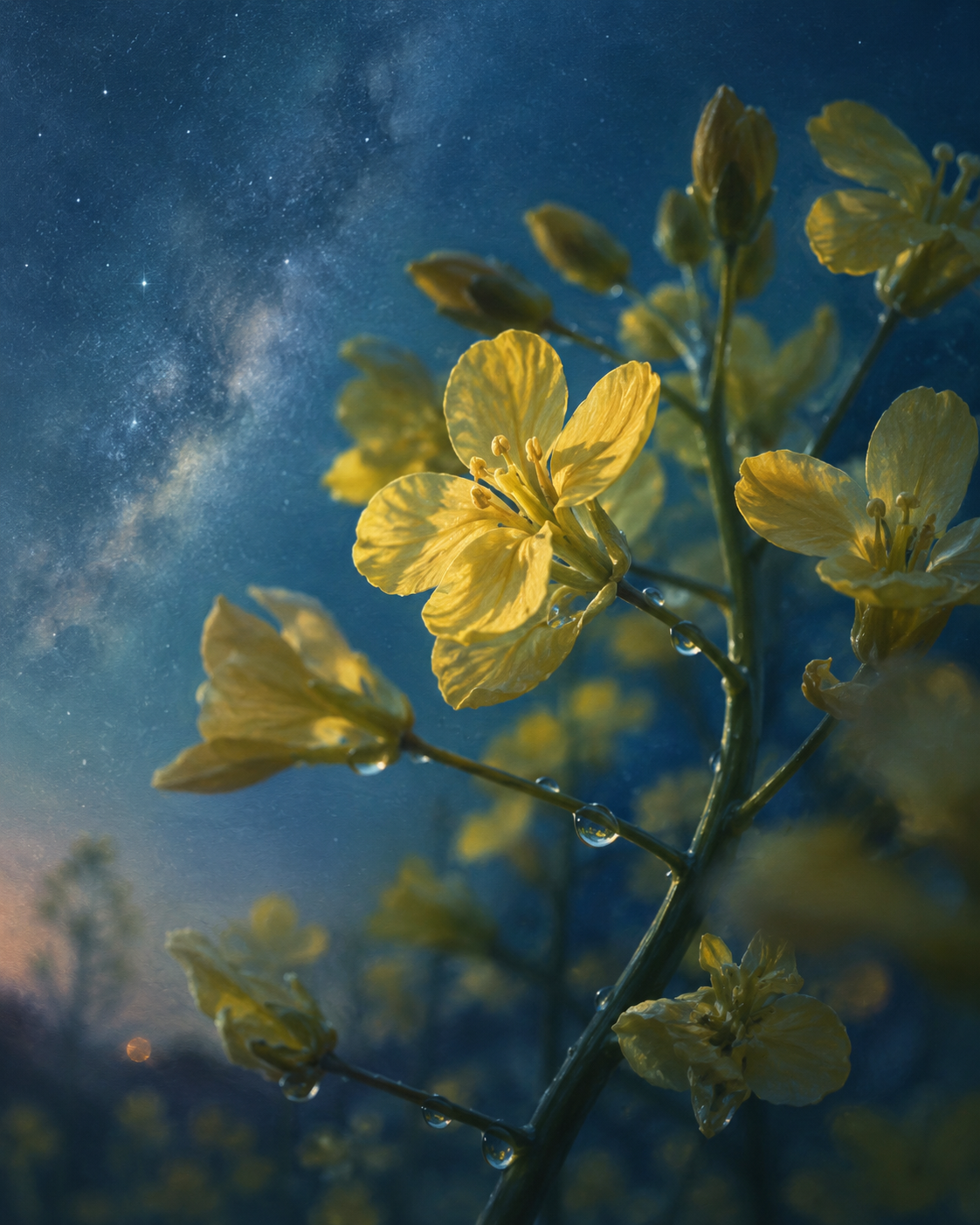
Canola Blossom Beneath Starry Skies
Critique
Introduction This painting sets a dew-covered yellow flowering branch against a deep celestial blue sky. Botanical detail and a visible band of stars occupy the same space, creating a contemplative encounter between nearby growth and immeasurable distance. Description A thick green stem climbs diagonally from the lower center toward the upper right. One open flower near the center receives the sharpest focus, with another cropped at right; buds and softer blossoms recede behind them. Rounded droplets hang from joints and petals. At left, a milky star band descends through the blue, while a warm glow and dark vegetation appear near the horizon. Analysis The branch's rising diagonal counters the galaxy's descending sweep, producing a broad X-shaped movement without literal intersection. Yellow advances against saturated blue, and small white stars repeat the highlights held inside the water drops. Selective focus separates the central petals and glossy stem from the diffuse background. Shadows within the ribbed petals prevent the flowers from becoming flat silhouettes. Interpretation and Evaluation The work connects microscopic and cosmic forms through repeated points of light. Each drop acts like a tiny lens, while the star field enlarges that motif beyond human scale. Careful botanical modeling, coherent complementary color, and layered depth demonstrate technical assurance. The conjunction is imaginative, yet restrained framing and uneven stages of bloom keep the scene rooted in observed plant life. Conclusion What begins as a nocturnal flower study becomes a meditation on scale and continuity. The painting's clear spatial design and tactile detail allow the fragile branch and remote sky to strengthen rather than compete with one another.
Same Subcategory
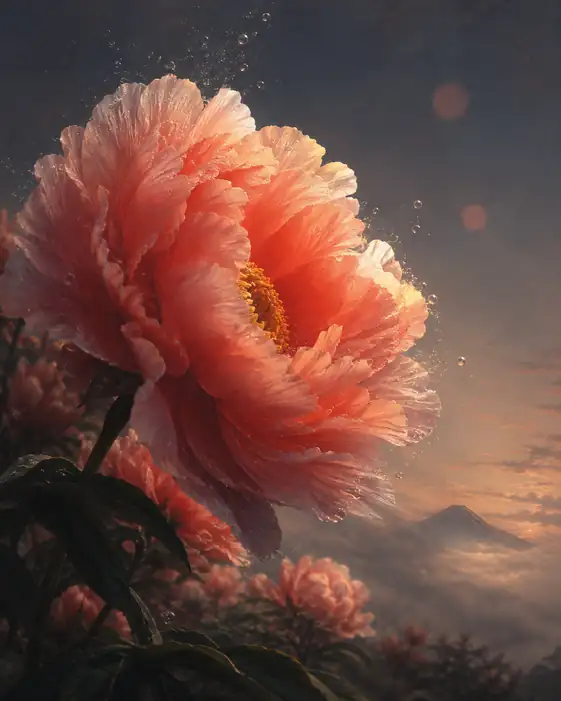 Crimson Peony and Dawn Over Mount Fuji
Similar Artworks
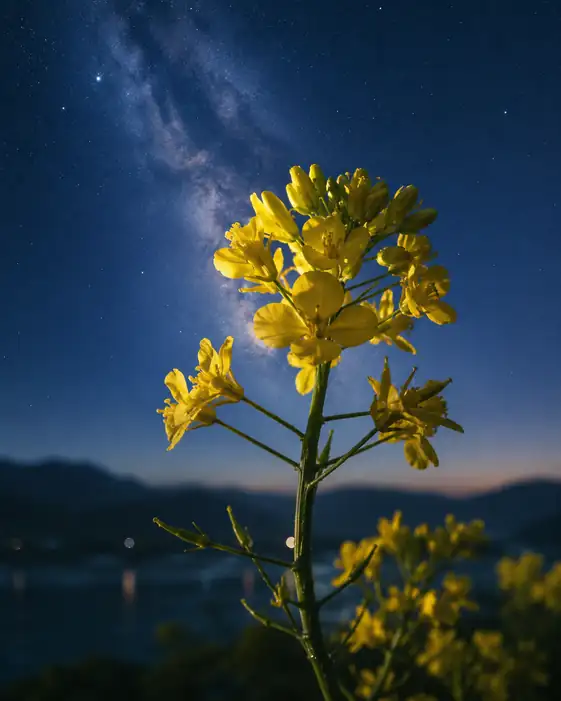 Milky Way and Golden Mustard Blossom
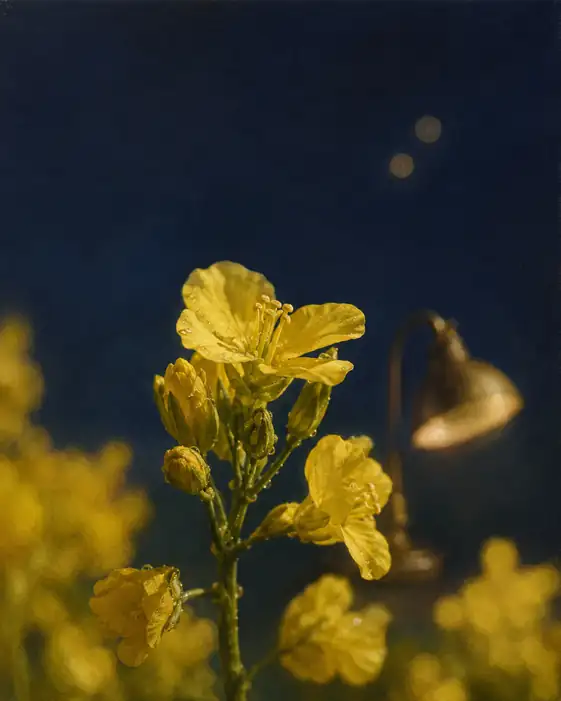 Canola Flower by the Brass Lamp
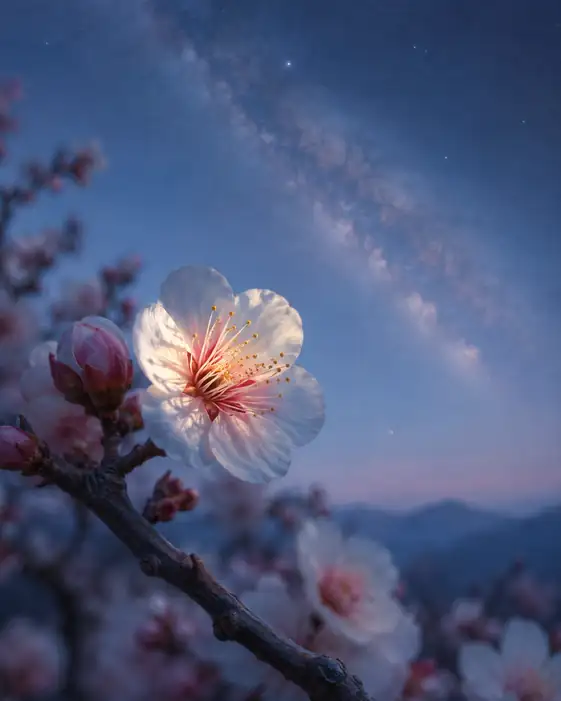 White Plum Beneath the Milky Way
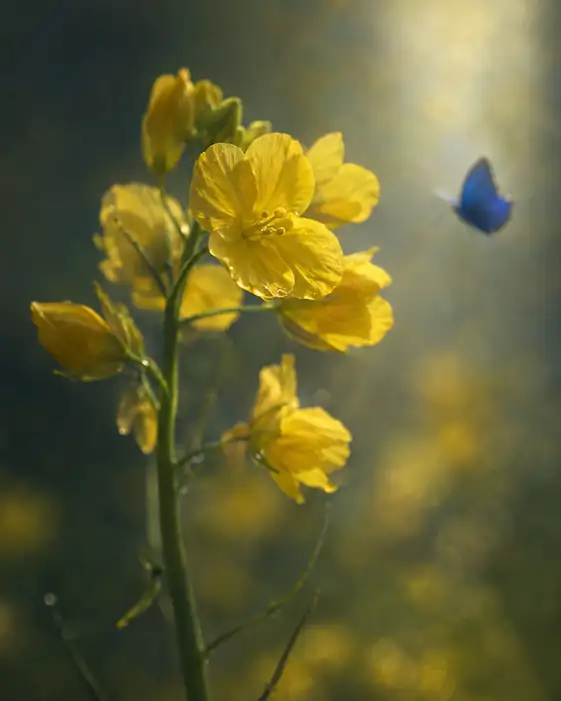 Blue Butterfly and Sunlit Canola Flower
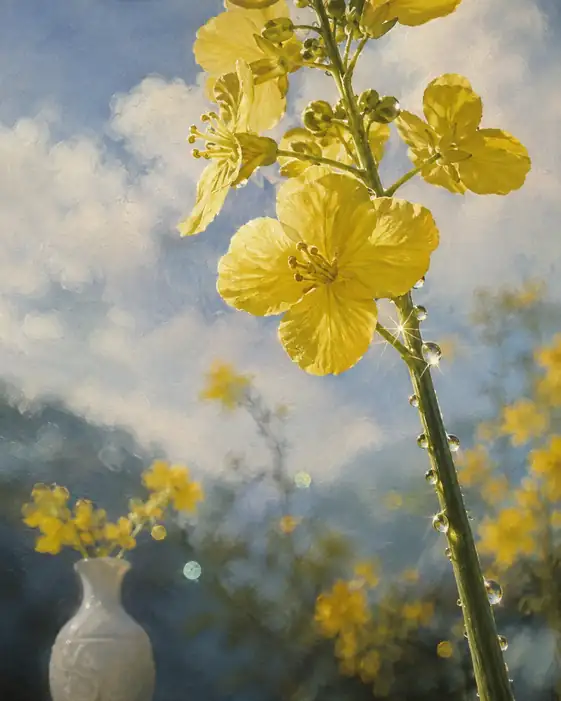 Sparkling Canola and Porcelain Vase
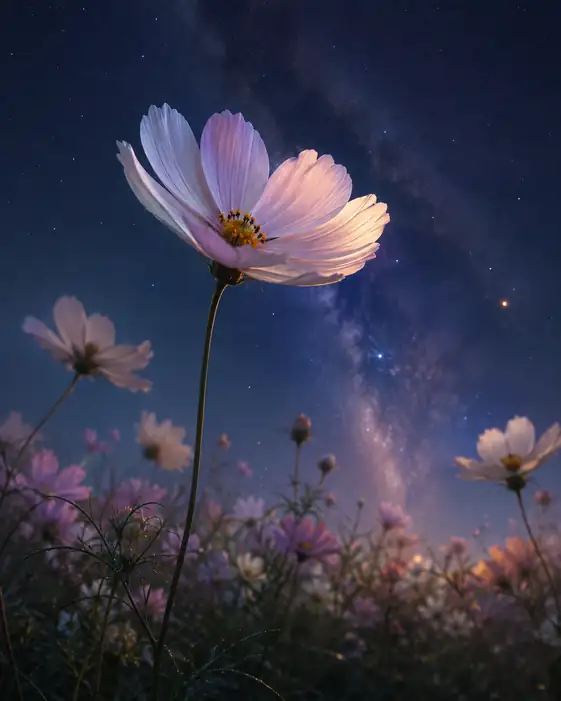 Cosmos Beneath the Starlit Sky
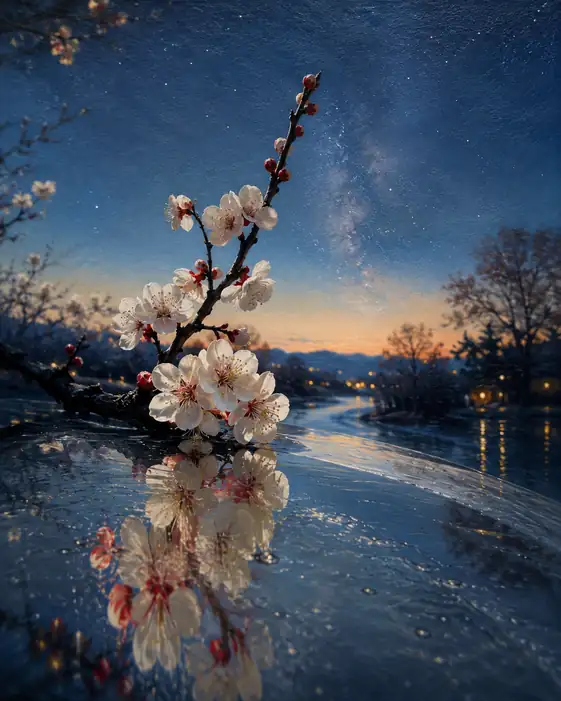 Plum Branch Under the Milky Way
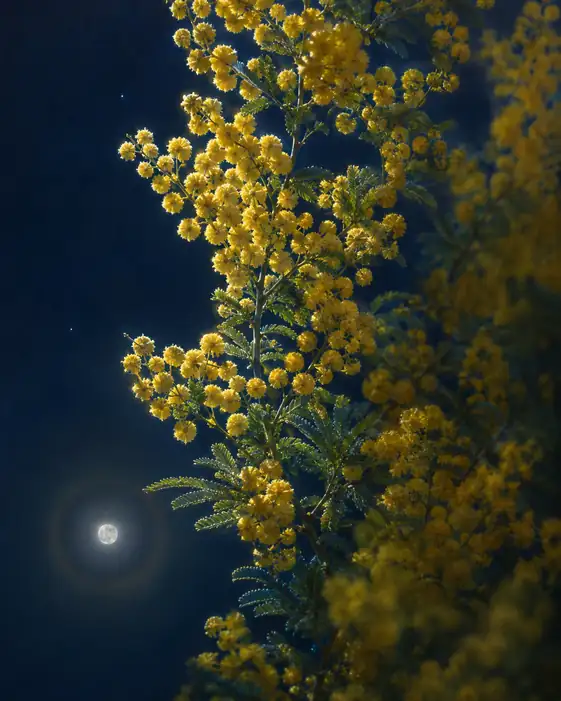 Moonlit Mimosa on a Silent Night
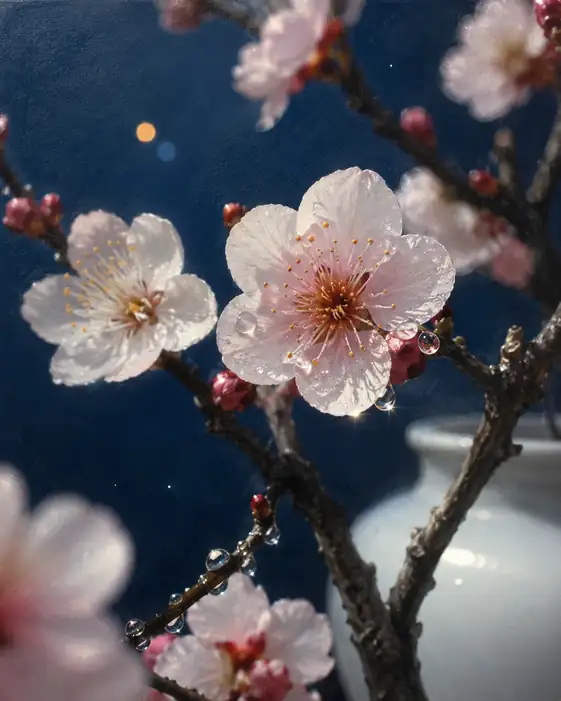 Dew-Kissed Plum Blossoms by White Porcelain
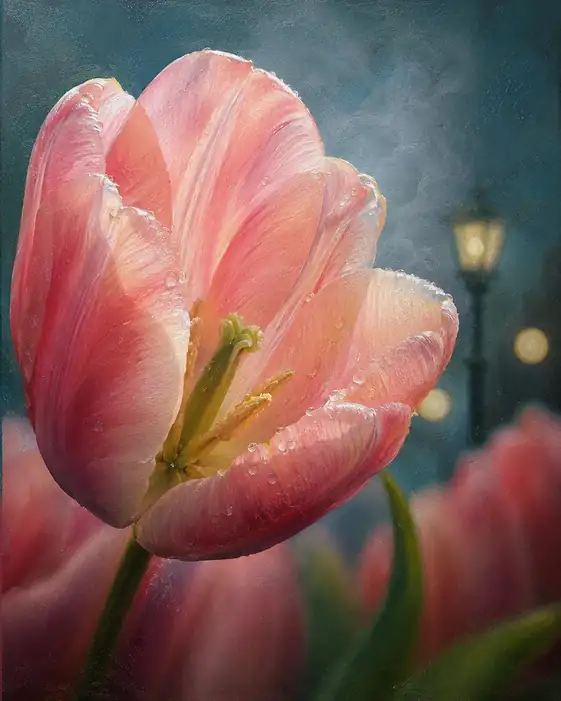 Pink Tulip Beneath the Night Lantern