
A Silent Gateway to the Universe
Critique
Introduction This painting presents a solitary torii and its reflection beneath a vertically rising Milky Way. The visible subject, color relationships, and lighting establish its basic visual information without requiring external context. Its first impression is direct, yet the arrangement encourages a slower reading of distance, surface, and atmosphere. Description The scene is organized so that the vertical celestial band answers the upright gate and its reflection. Supporting forms clarify the setting while leaving the principal motif dominant. Light separates reflective passages, solid edges, and softer zones of air. Foreground detail gives way gradually to broader shapes in the distance. Analysis The composition gains coherence from repeated lines, balanced intervals, and a controlled distribution of light and dark. The technique relies on deep tonal layering, small light points, and restrained reflected color. Color contrast guides attention, while shifts in scale create convincing depth. The descriptive skill is strongest where distinct textures remain legible without disrupting the unity of the whole. Interpretation and Evaluation The image can be interpreted as a study of human structure placed within a far larger cosmic order. Its composition is persuasive because the principal direction is reinforced by secondary rhythms rather than isolated from them. The color design balances vivid accents with quieter supporting tones. Originality emerges through the transformation of familiar scenery into a concentrated pattern of light, movement, and spatial tension. Conclusion Overall, the work joins careful observation with a deliberately heightened atmosphere. What initially appears to be a straightforward view gradually reveals a sustained examination of reflection, rhythm, and visual passage. The painting succeeds because technique, color, and structure consistently support the same measured mood.
Same Subcategory
 Beyond the Rain-Dark Gate
Similar Artworks
 Cosmic Dialogue at the Red Gate
 Twilight's Quiet Companion
 A Deer Crosses the Divine Twilight
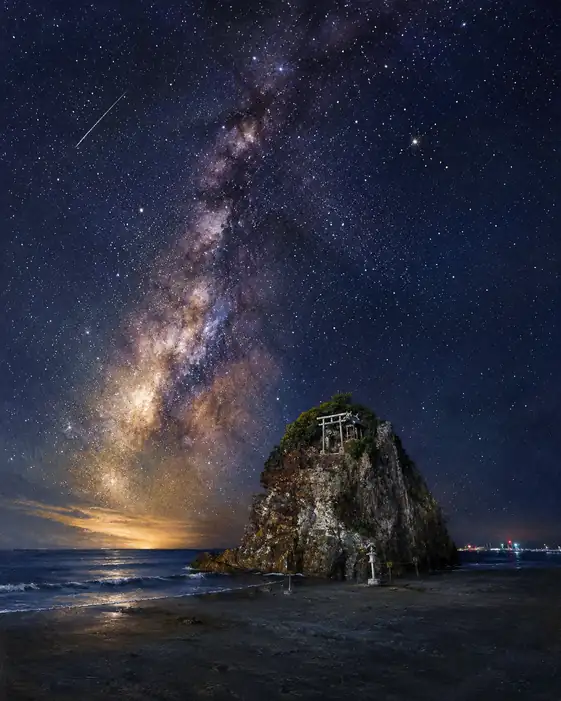 Celestial River above the Ancient Coastal Isle
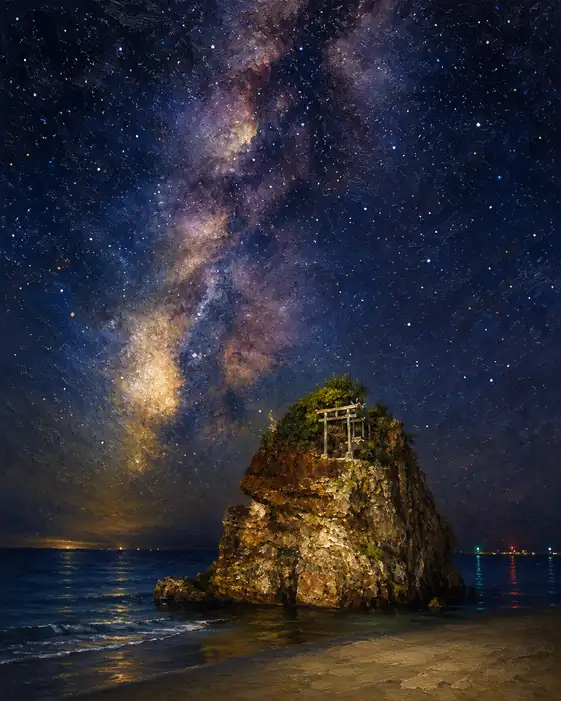 Torii of the Sacred Isle beneath the Milky Way
 Eternal Reverie: The Sacred Tide
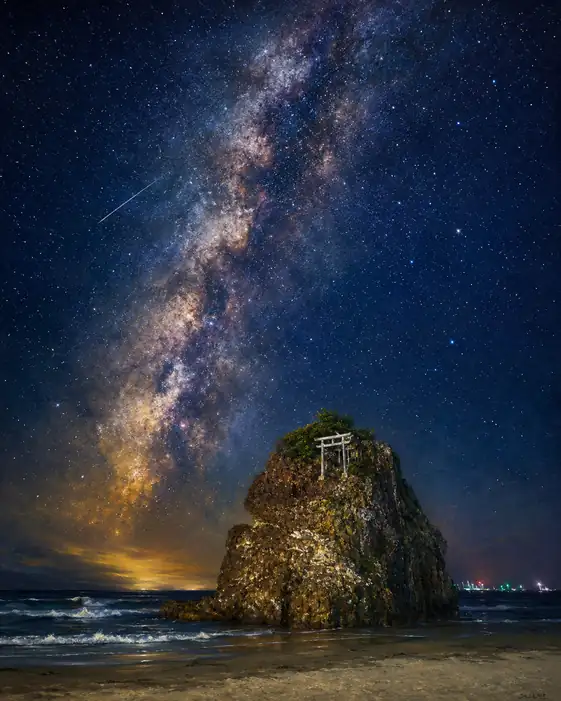 Shooting Star over the Sacred Coastal Torii
 Plum Branch Under the Milky Way
 The Vermilion Gate at Evening's Edge
 Tears of the Starry Expanse