
Awakening of the Sleeping Dragon
Critique
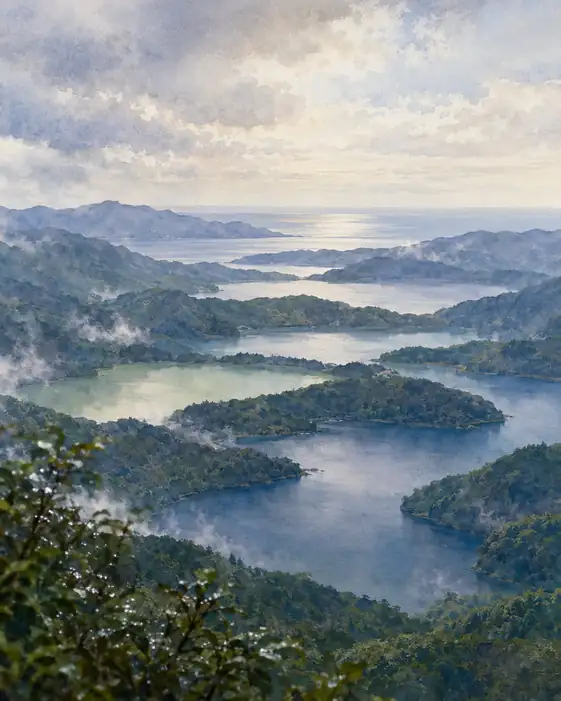
Introduction This painting presents a winding chain of tree-covered islets crossing a pale misty lake. Its first impression is shaped by blue, mint green, lavender, and dark green, which establish a clear visual identity and an immediate emotional temperature. The subject is familiar, yet its staging encourages slow and attentive looking. Description The principal motif is organized through the sinuous landform leads from foreground to the glowing distance. Surrounding details clarify the setting without competing with the focal form. Light travels across the surfaces, distinguishing solid edges, reflective passages, and softer atmospheric zones. Analysis The composition gains stability from repeated curves, diagonals, and intervals of open space. The handling relies on soft washes and fine foliage textures. These choices create depth while preserving a decorative coherence. Color contrast directs attention, and changes in scale keep the eye moving between the main subject and its context. Interpretation and Evaluation The image may be read as continuity and quiet passage suggested by connected islands. Its descriptive skill is evident in the differentiated textures, while the controlled arrangement demonstrates strong compositional judgment. The color design is persuasive because vivid accents are balanced by quieter supporting tones. Its originality lies less in novelty of subject than in the imaginative transformation of visible materials through light and arrangement. Conclusion Overall, the painting combines careful observation with a deliberately heightened atmosphere. What first appears to be a direct presentation gradually reveals a study of rhythm, surface, and spatial tension. The work is most successful when technique, color, and structure reinforce the same focused mood.
Same Subcategory
 Where the Sun Writes Hope on the Waves
Similar Artworks
 The Awakening of the Misty Dragon
 A Morning When Pines and Islands Unfold
 Awakening in Soft Pink
 Sailing the Cobalt Summer Sky
 Beyond the Island, Beyond the Sea, Snowy Peaks
 Whispers of the Misty Archipelago
 Morning Planted in a Thousand Mirrors
 Five Waters Dreaming of the Sea
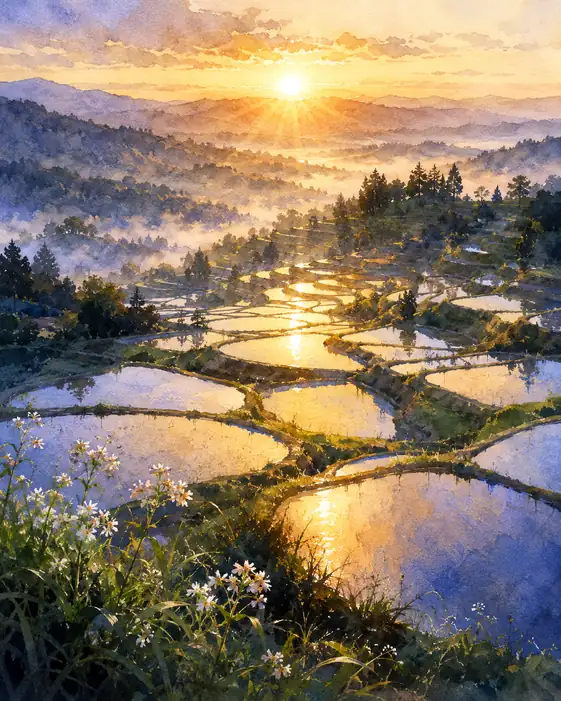 As Stars Fade, the Mountain Mirrors Embrace the Rising Sun
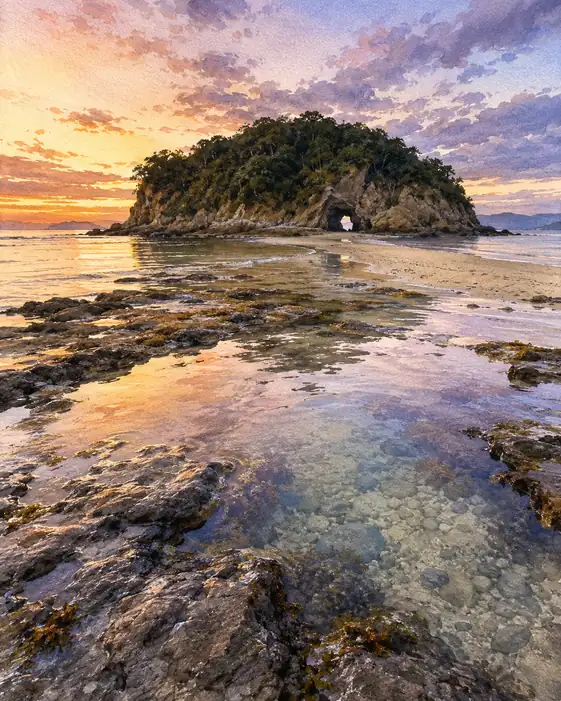 Low Tide Opens a Secret Door