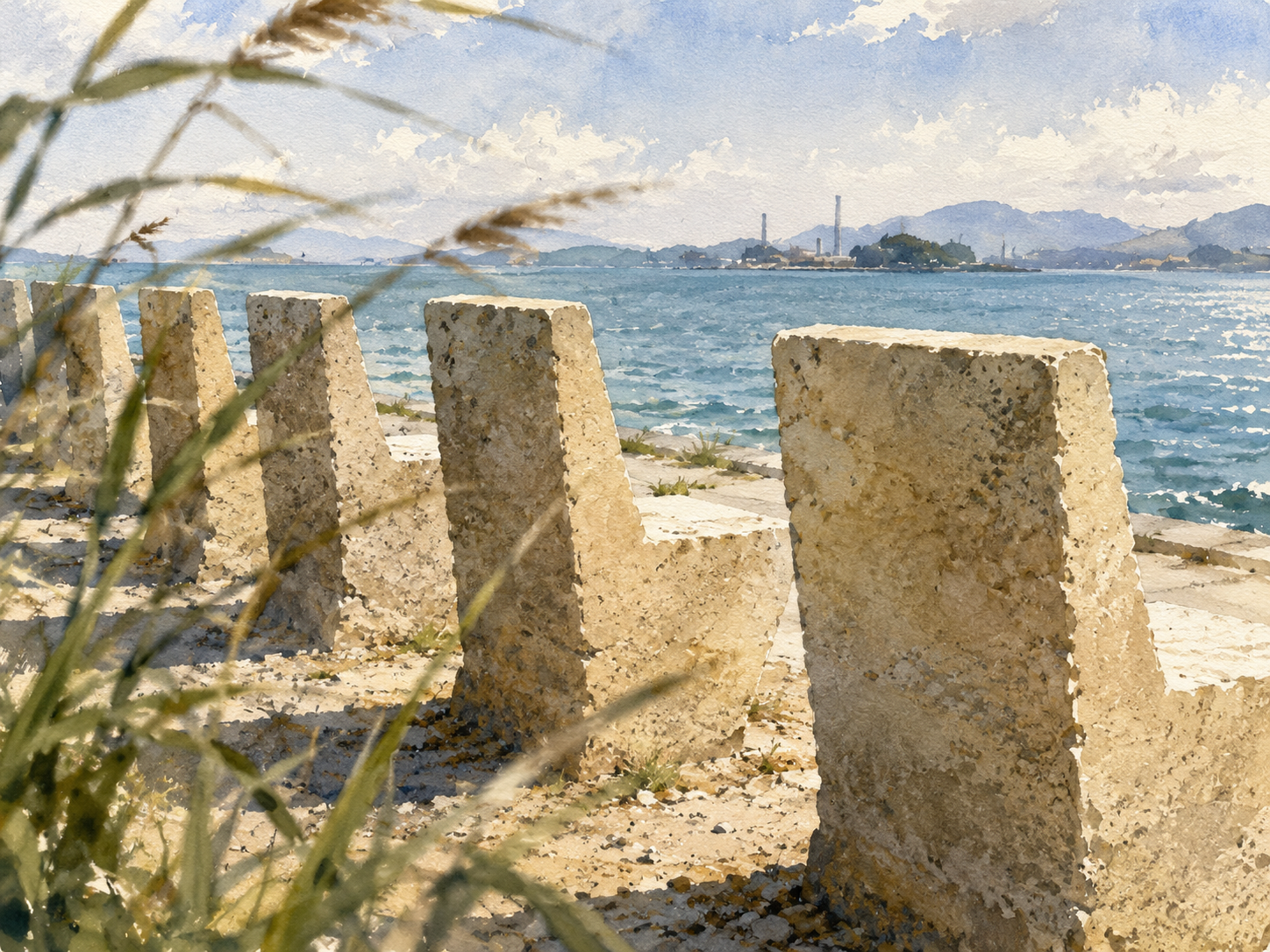
Dialogue Between Stone and Sea
Critique
1. Introduction This watercolor painting presents a contemplative coastal scene that explores the quiet intersection between industrial infrastructure and the natural marine environment. The composition focuses on a row of weathered concrete barriers lining a shore, set against a backdrop of a shimmering bay and a distant industrial skyline. The artist uses a delicate, realistic style to capture a moment of stillness, where the remnants of human activity appear to have settled into a peaceful coexistence with the vastness of the sea and sky. 2. Description In the mid-ground, a series of monolithic concrete blocks stretches diagonally across the frame, their surfaces characterized by a rough, granular texture and subtle variations in sun-bleached beige and grey. The sea beyond is rendered with a lively pattern of blue and turquoise ripples, reflecting a bright, clear sky filled with soft, white cumulus clouds. In the far distance, the silhouettes of factory chimneys and industrial buildings are visible on a low-lying island or coastline, backed by a range of faint, bluish mountains. The immediate foreground is occupied by out-of-focus blades of tall grass, which create a sense of depth and suggest the viewer's physical presence on the shoreline. 3. Analysis The work showcases an impressive command of watercolor, particularly in the handling of light and shadow on the geometric forms of the concrete barriers. The artist employs a controlled application of pigment to simulate the abrasive quality of the cement, contrasting it with the fluid, transparent washes used for the water and atmosphere. The composition is grounded by the strong diagonal of the barriers, which effectively leads the eye toward the horizon and enhances the sense of spatial recession. The use of a shallow depth of field, represented by the blurred foreground grass, is a sophisticated technique that mimics photographic perspective, adding a contemporary feel to the traditional medium. 4. Interpretation and Evaluation This painting can be interpreted as a meditation on the quietude of modern industrial landscapes and the persistent beauty found in utilitarian objects. The juxtaposition of the heavy, permanent concrete with the transient, shifting elements of nature—the water, clouds, and swaying grass—suggests a dialogue between human permanence and environmental flux. The distant factories, rather than appearing intrusive, are integrated into the atmospheric perspective, hinting at a nostalgic or even melancholic view of the industrial age. Technically, the artist's ability to balance precise architectural detail with the spontaneous qualities of watercolor is highly successful, resulting in a work of great tonal harmony. 5. Conclusion Through its thoughtful composition and refined execution, the painting captures the unique atmosphere of a coastal industrial periphery with remarkable sensitivity. The initial focus on the stark concrete forms gradually shifts toward an appreciation for the vast, airy space of the bay and the distant mountains. It is a masterful exploration of how light and medium can transform a seemingly mundane scene into a powerful visual narrative. Ultimately, the work leaves a lasting impression of quiet dignity and the subtle, often overlooked beauty of the places where the built world meets the sea.
Same Subcategory
 The Golden Pulse of Itaipu
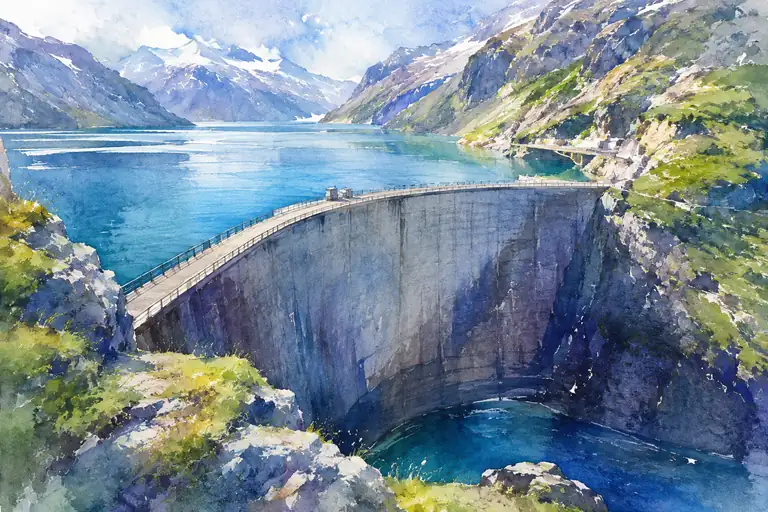 Arch of the Emerald Sanctuary
Similar Artworks
 Breath of the Emerald Shore
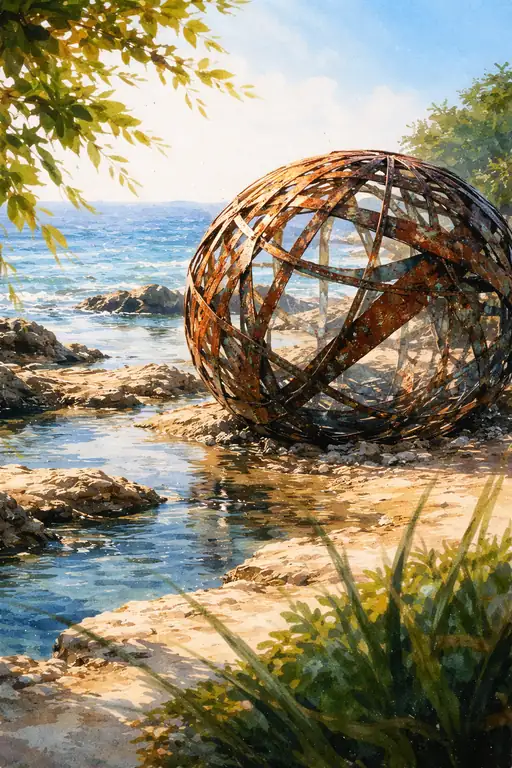 Echoes of the Sea in a Rusted Sphere
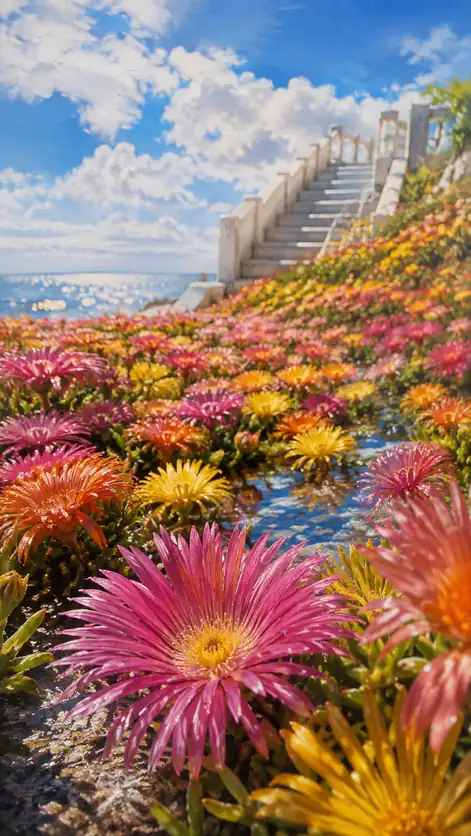 Coastal Stairway and Livingstone Daisies
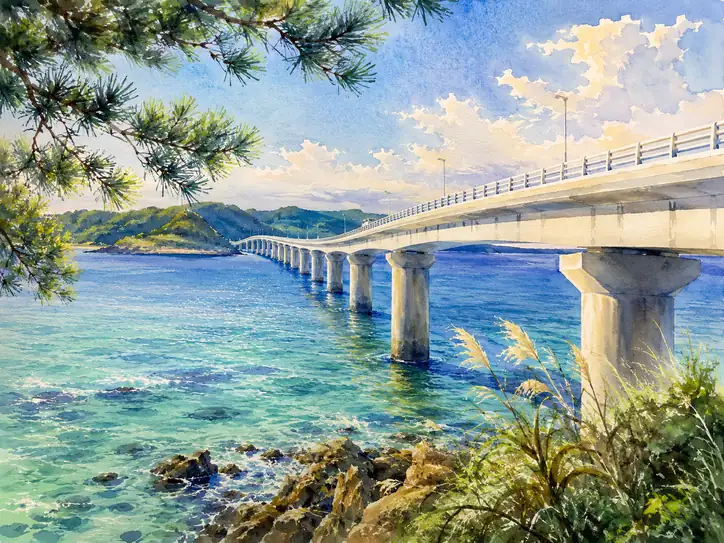 A Path Suspended in Blue
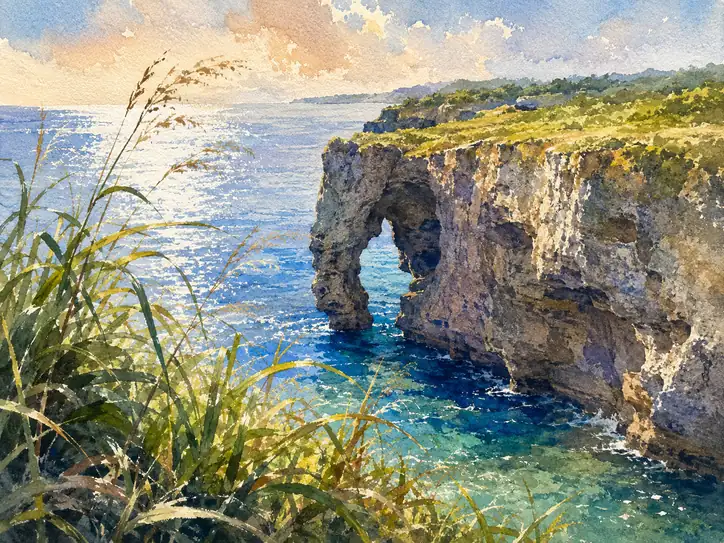 Glance of the Sea through the Stone Arch
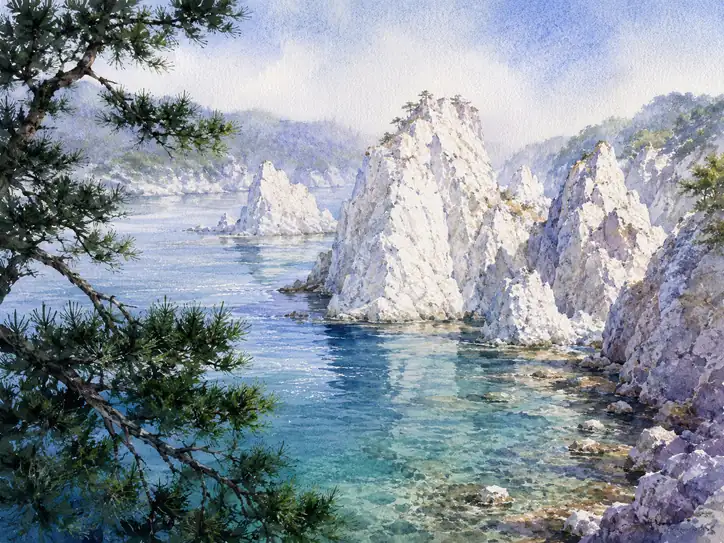 The Shore of White Silence
 Infinite Azure: The Ocean's Grand Vista
 Glimmering Jewels of the Cerulean Sea
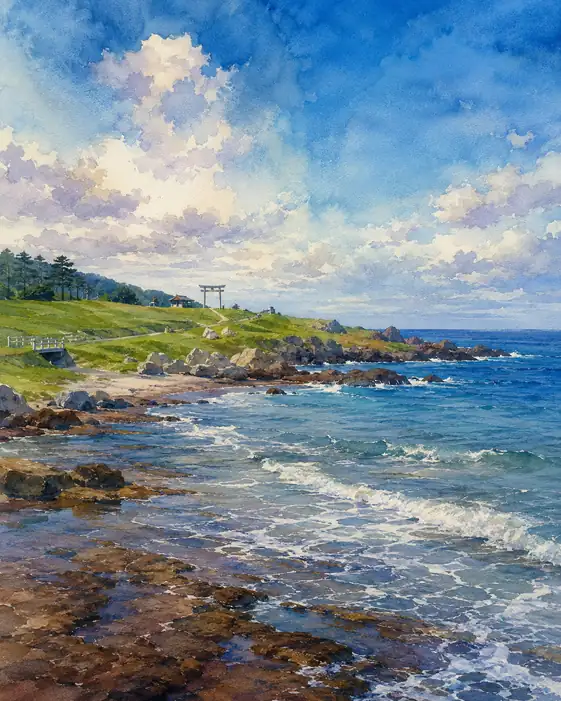 A Small Gate Beneath the Infinite Blue
 The Heartbeat of the Sleeping City