
Stalwart Beacon in the Golden Wind
Critique
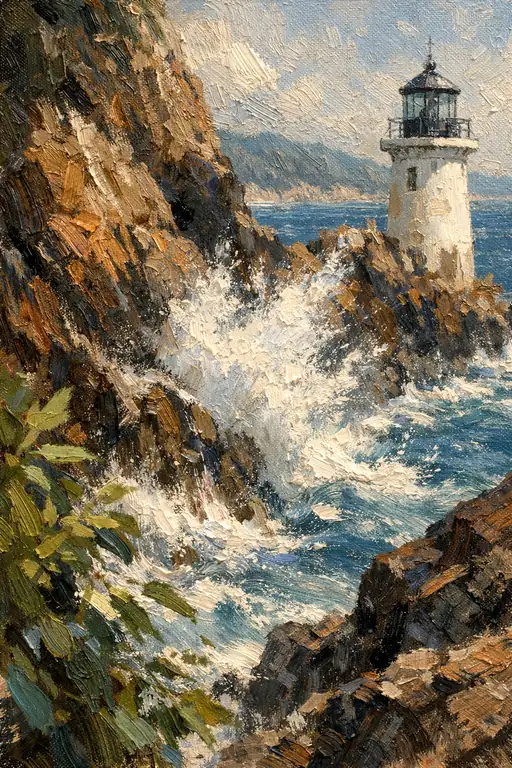
1. Introduction This work is a coastal landscape showing a lighthouse above a rocky shoreline under expansive evening light. The exact place, date, and medium cannot be confirmed from the image alone, yet the painting clearly studies how open air, sea distance, and exposed ground can be held together within a single view. Its first effect is bright and invigorating, though closer attention reveals a notably measured design. 2. Description A black-and-white lighthouse occupies the right side of the scene, set on a low cliff edged by fence lines and sparse equipment. Across the left foreground, reeds and coarse grasses sweep inward, while below them dark rocks interrupt the blue water. The horizon remains clearly visible, and above it a large field of clouds spreads in creamy gold, lavender gray, and blue. 3. Analysis This composition gives generous space to the meeting of sea and sky. The tower anchors the right edge, but the eye moves broadly across the horizon before returning through the slanting grasses in front. Broken, impasto-like strokes animate the clouds and vegetation, yet the values are well ordered, so atmosphere and structure remain in balance. 4. Interpretation and Evaluation The image suggests not danger but exposure and steadiness. The lighthouse acts as a stable marker, while the grasses register wind and the sea records constant change. The work is effective because descriptive accuracy, spatial clarity, color harmony, and energetic handling are all aligned; its originality lies less in motif than in the lucid orchestration of familiar elements. 5. Conclusion At first the painting seems mainly a celebration of light on the coast, but sustained looking shows a more deliberate meditation on orientation and openness. It leaves a strong impression because the broad air, the rough ground, and the fixed tower are resolved into a calm but active whole.
Same Subcategory
Similar Artworks
 Sentinel of the Stripped Shore
 The Beacon of the Golden Hour
 The Beacon over the Wind-Swept Ridge
 Sentinel of the Azure Breeze
 A Beacon against the Roaring Tide
 The Silent Guide of the Burning Sky
 The White Path to the Sea Beacon
 The White Beacon on the Emerald Cliff
 Steadfast Soul Against the Roaring Tides
 The Silent Beacon of the Sea's Serenade