
Sentinel of the Stripped Shore
Critique
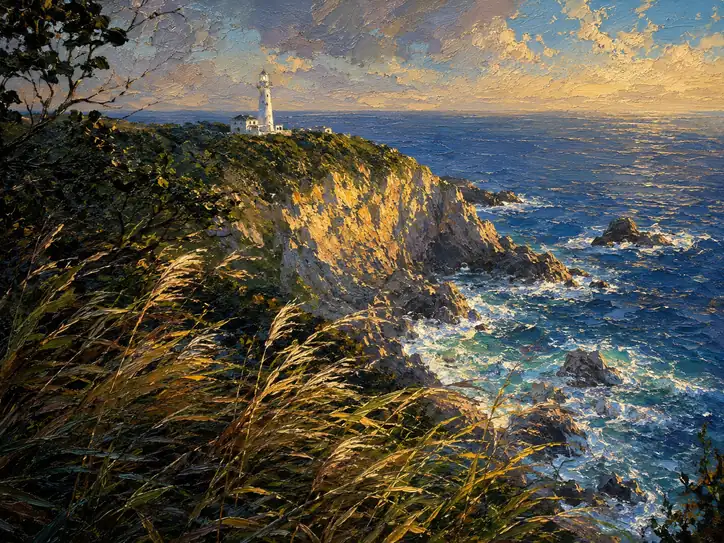
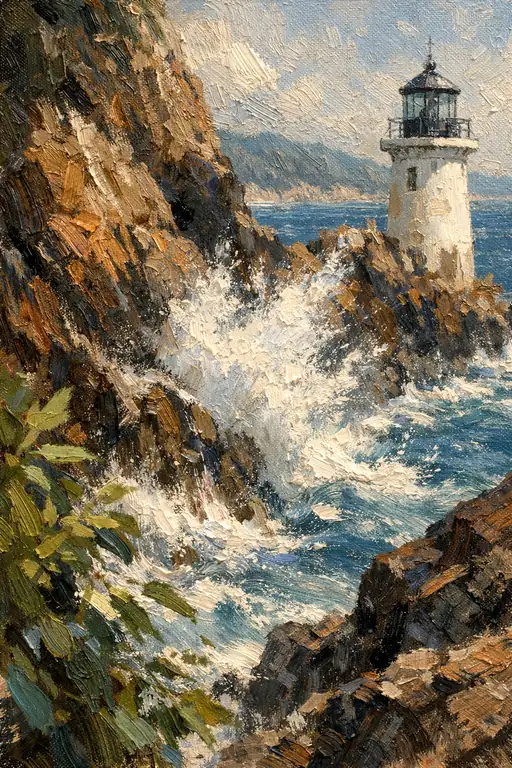
1. Introduction This work is a coastal landscape centered on a striped lighthouse above a rocky sea. Its exact location, date, and medium cannot be confirmed from the image alone, yet the scene is rendered with unusual emphasis on weather, light, and the exposed character of the shore. The first impression is energetic, but the painting is carefully organized rather than merely dramatic. 2. Description The lighthouse stands at the right on a grassy headland, rising above dark rocks and restless water. At the left and across the lower foreground, tall reeds bend sharply in the wind, while the horizon opens toward distant land beneath a wide sky. Broken clouds carry warm gold and cool blue, suggesting low sunlight near the edge of day. 3. Analysis The composition depends on a strong opposition between the vertical tower and the diagonals of grasses, cliff, and cloud bands. Thick, directional brushwork gives the sky and foreground a tactile surface, and the sea is built from alternating strokes of blue, white, and gray that imply movement without losing structure. Light is distributed broadly rather than concentrated at a single point, which allows the scene to feel expansive even within a steep vertical format. 4. Interpretation and Evaluation The painting presents the lighthouse as more than a descriptive object; it becomes a measure of endurance within a volatile environment. The contrast between fixed architecture and wind-driven vegetation carries the image emotionally, while color, brushwork, and spatial clarity keep that tension intelligible. Its descriptive power, forceful composition, vivid palette, and confident handling of paint make the work persuasive. 5. Conclusion At first the scene reads as a vivid seacoast view, yet sustained looking reveals a disciplined study of resistance, motion, and atmosphere. The image succeeds because its intensity is supported by clear structure, and the viewer leaves with a stronger sense of how light and wind organize the place.
Same Subcategory
Similar Artworks
 Stalwart Beacon in the Golden Wind
 The Beacon of the Golden Hour
 The Beacon over the Wind-Swept Ridge
 Sentinel of the Azure Breeze
 A Beacon against the Roaring Tide
 The Silent Guide of the Burning Sky
 The White Path to the Sea Beacon
 The White Beacon on the Emerald Cliff
 Steadfast Soul Against the Roaring Tides
 The Silent Beacon of the Sea's Serenade