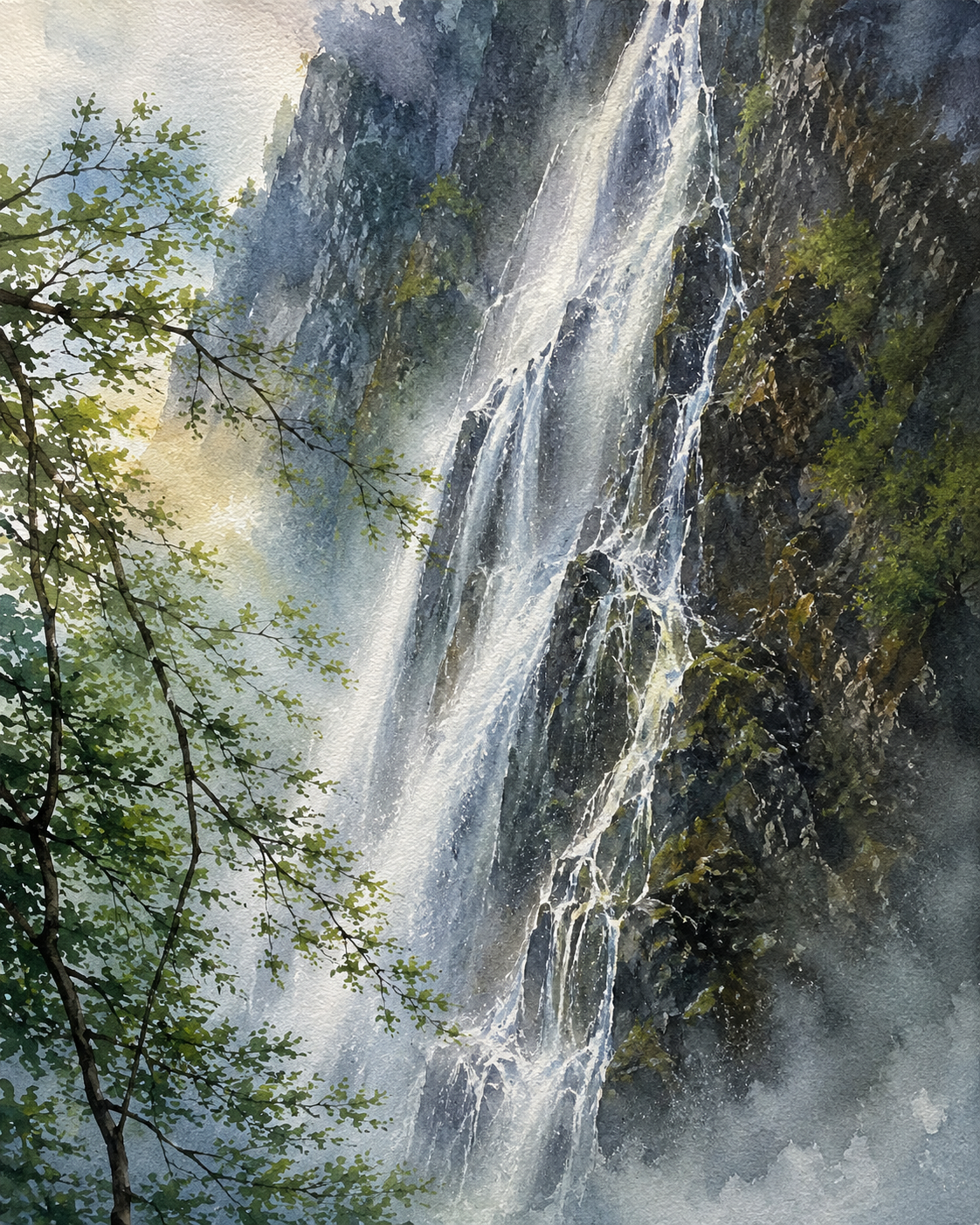
The Mountain's Silver Thread
Critique
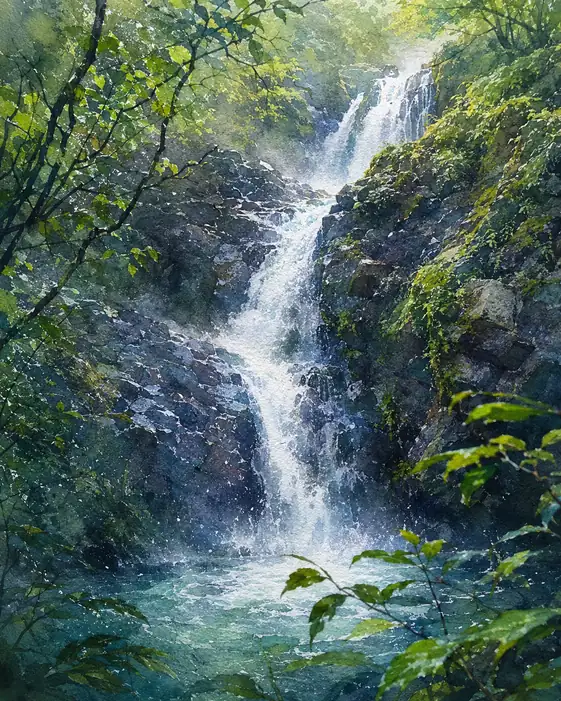
1. Introduction This work presents a vertical landscape centered on a waterfall descending beside a dark cliff. Fresh greens, cool mist, and exposed rock establish a clear natural setting and an immediate sense of scale. The picture is simple in motif, yet carefully ordered in tone and placement. 2. Description A slender tree enters from the left, spreading small leaves across the upper and lower edges. White water slips down a rugged wall of gray-brown stone marked by moss, while spray gathers below and softens the background. 3. Analysis The main movement runs diagonally from upper right to lower center, balanced by the branching lines on the left. Strong contrast between bright water and dark rock clarifies the forms, and a restrained range of blues, greens, and earth tones keeps the image unified. Varied handling suggests wet stone, drifting vapor, and the changing density of the fall. 4. Interpretation and Evaluation The scene may be read as a meeting of permanence and motion. Rock provides a stable structure, while the water introduces change and light. The painting is effective in description, composition, color balance, and technique, and its modest originality lies in the calm control of these relationships. 5. Conclusion At first, the image seems to depend mainly on the force of the fall. Closer attention shows that its real strength lies in the measured relation between foliage, cliff, mist, and light. The impression shifts from spectacle to a more deliberate understanding of structure.
Same Subcategory
 Where the Heavens Meet the Jungle
Similar Artworks
 Breath of Light Amidst the Ancient Stone
 Whispers of the Moss-Wreathed Veil
 Melody of the Hidden Valley
 The Luminous Veil of the Forest Cascade
 A Secret Symphony of the Emerald Waters
 Echoes of the Vertical Roar
 Torrential Breath
 The Breath of the Gorge
 Whispers of the Rushing Veil
 Breath of the Sacred Torrent