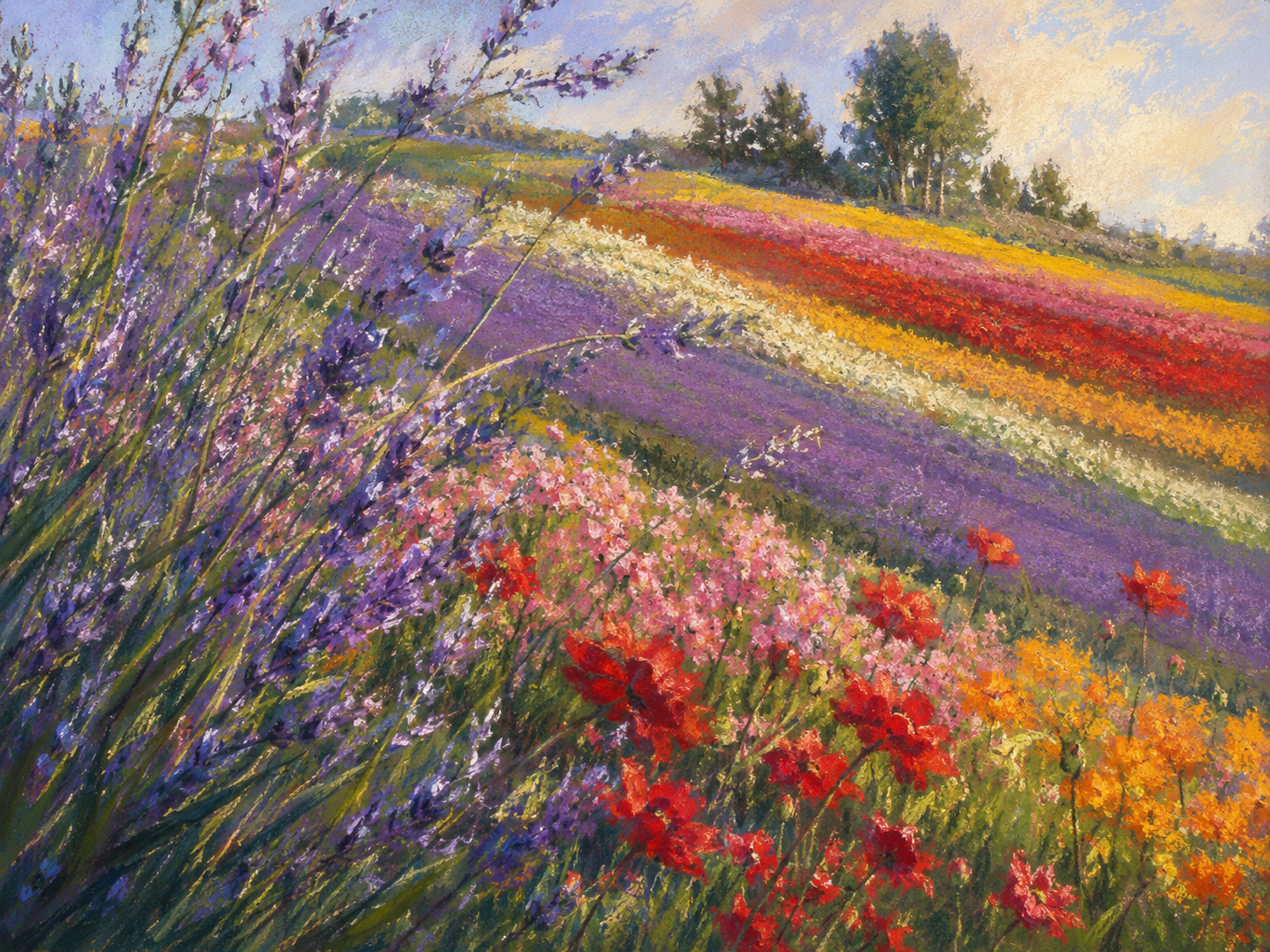
A Gradient of Summer Dreams
Critique
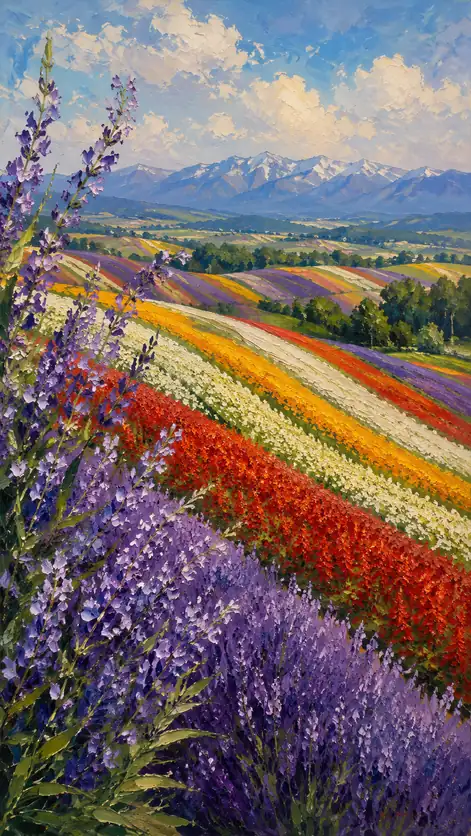
1. Introduction This work is a landscape painting of a flowering hillside under clear daylight. Seen from a low vantage point, the blossoms rise close to the viewer while the slope opens gradually toward a pale sky. The light is gentle, but the surface remains visually active. 2. Description Tall purple flower stalks fill the left foreground and lean diagonally across the scene. Behind them, bands of violet, white, red, yellow, and pink flowers spread across the hill. A small row of trees marks the upper edge, and warm light enters from the right, softening the distant air. 3. Analysis The composition depends on the contrast between the large diagonal cluster in front and the layered color bands behind it. Cool violets anchor the foreground, warmer reds and yellows advance through the middle ground, and the alternating directions create clear depth. Loose broken brushwork gives the field texture without excessive detail. 4. Interpretation and Evaluation The scene can be read as an image of seasonal abundance shaped by visual order. Its strength lies less in botanical precision than in the balanced relation of color, light, and direction. The familiar subject gains freshness through disciplined structure, effective brushwork, and a stable overall design. 5. Conclusion At first glance, the painting seems to celebrate richness of color alone. Continued looking shows that its stronger achievement is the careful organization of diagonals, stripes, and light. Decorative abundance is thus turned into a convincing landscape with clarity and compositional control.
Same Subcategory
Similar Artworks
 A Rainbow Journey to the Horizon
 The Earth's Melodic Bloom
 Breeze across the Rainbow Hill of Furano
 Tactile Bloom beneath the Snow-Capped Peak
 Autumn's Shimmering Tapestry
 Autumn Whispers in the Sunlit Gorge
 Twilight Reflections in the Glass Prism
 Joyful Chorus of Summer Blooms
 Impressions of a Fleeting Morning
 Sunflowers and the White Cottage at Sunset