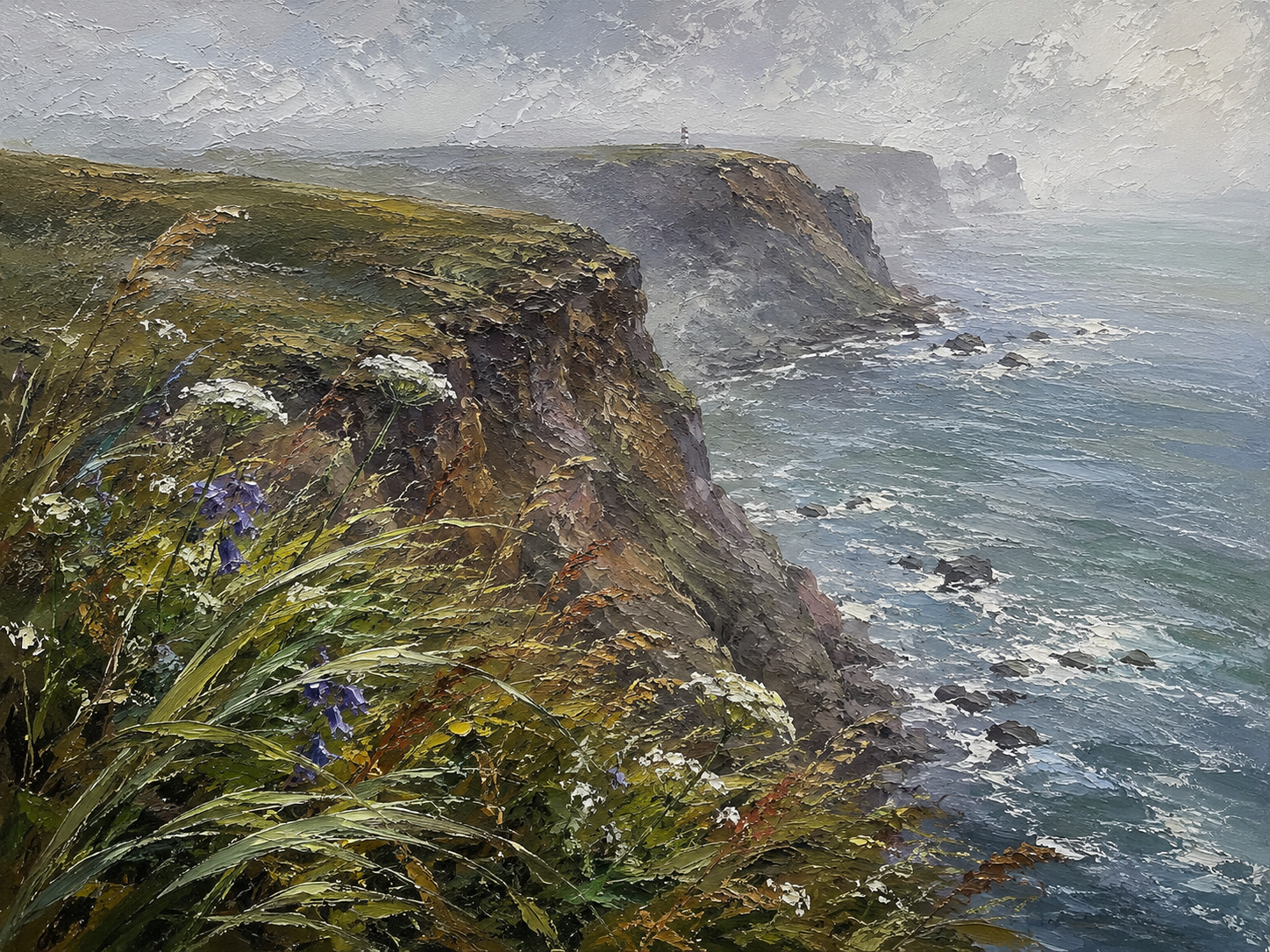
Where the Earth Meets the Surge
Critique
1. Introduction This coastal landscape presents a high cliff edge overlooking a rough sea under a pale, wind-laden sky. The work is less concerned with scenic calm than with exposure, erosion, and the unstable meeting of land and water. It achieves its force through the direct articulation of cliff forms and the physical handling of paint. 2. Description The foreground is filled with coarse grasses and small wildflowers growing close to the cliff's edge. Beyond them, the land falls steeply into the sea, where broken rock and white surf mark the shoreline below. Farther back, additional headlands recede into haze, and a tiny lighthouse or marker appears on one distant promontory. The water occupies the right half of the image, its surface broken by scattered rocks and bands of foam. 3. Analysis The composition is dominated by the diagonal plunge of the cliff, which guides the eye from the left foreground toward the distant coast and sea. Thick, broken brushwork gives the cliff face a brittle, weathered quality, while the water is described through broader, more fluid strokes. Greens, ochres, slate grays, and sea blues define a restrained palette shaped by overcast light. Atmospheric perspective softens the more distant cliffs and keeps the immediate precipice sharply present. 4. Interpretation and Evaluation The painting can be read as an image of coastal endurance, where plant life, rock, and sea are all subject to continual abrasion. Its strengths lie in the convincing description of terrain, the dynamic but controlled composition, and the careful balance between detail and openness. Technical skill is visible in the treatment of rocky edge, foaming water, and receding haze. The work avoids sentimentality and instead presents the coast as a place of persistent physical tension. 5. Conclusion At first, the dramatic drop of the cliff commands attention, but with longer viewing the relationships among foreground growth, distant headlands, and moving water become equally important. The scene broadens from a single precipice into a complete coastal system. Through strong structure and tactile paint, the work gives the shoreline a durable and unsentimental power.
Same Subcategory
 The Beacon’s Solitary Path
Similar Artworks
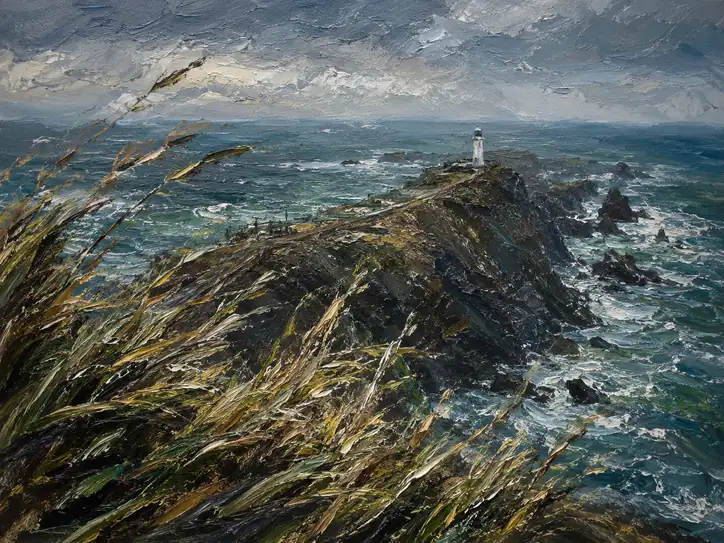 The Tower of Unyielding Light
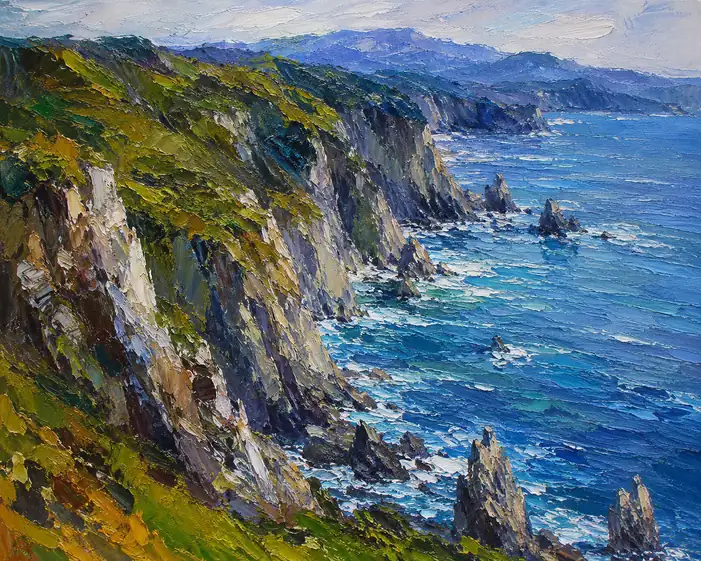 The Pulse of the Receding Headlands
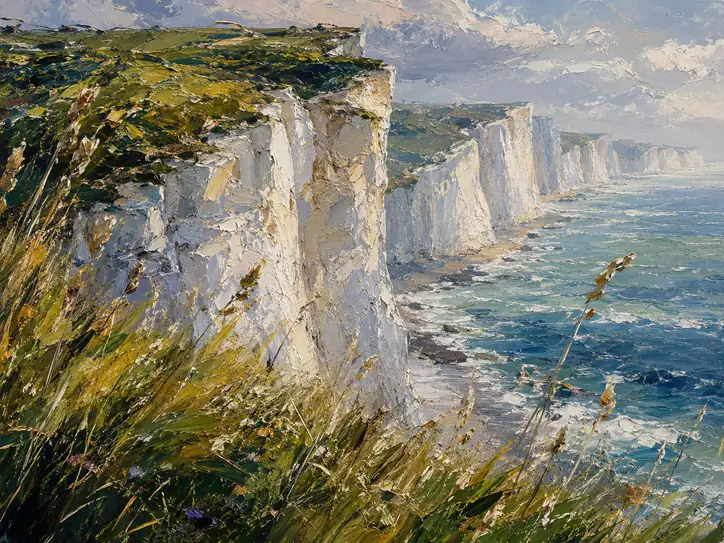 The Earth's White Breath Against the Tide
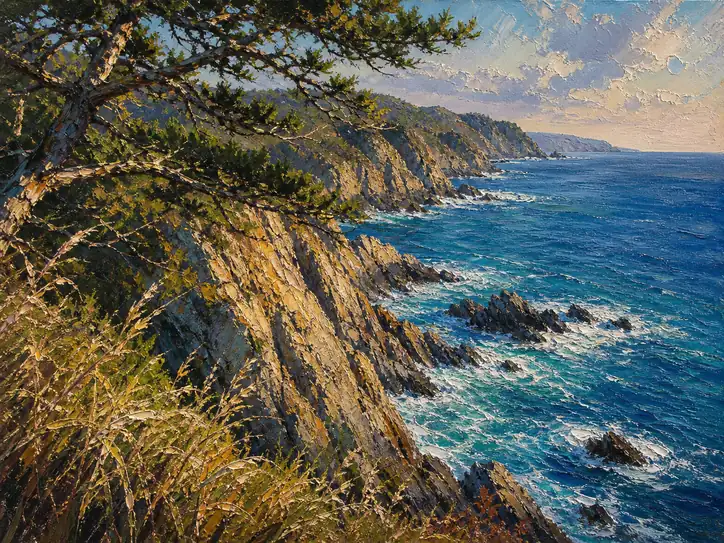 The Golden Precipice over the Cerulean Surge
 Sentinel Above the Blossoms
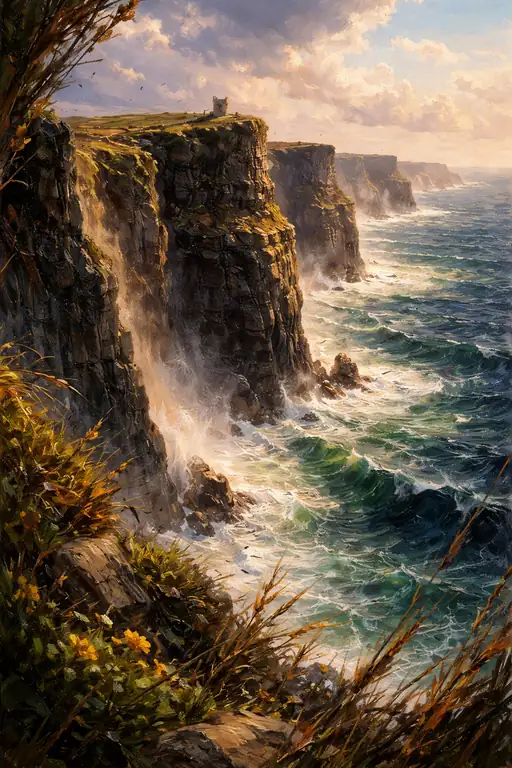 The Solitary Watcher at the Edge of the World
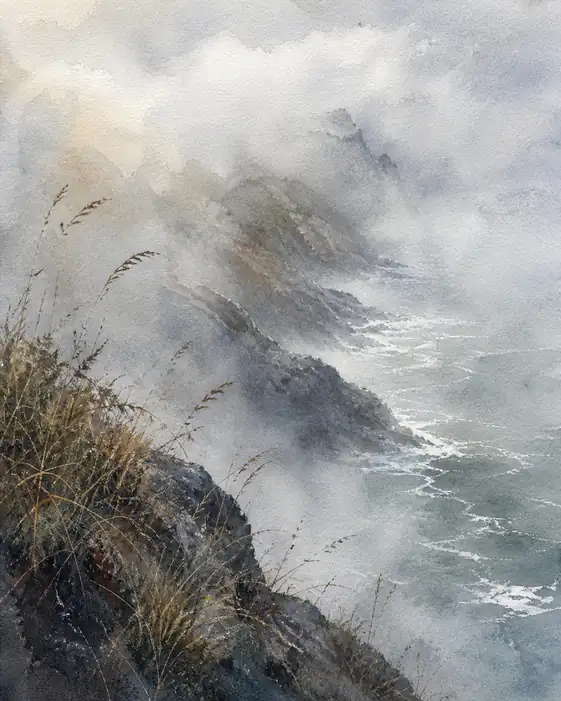 Solitude Beyond the White Veil
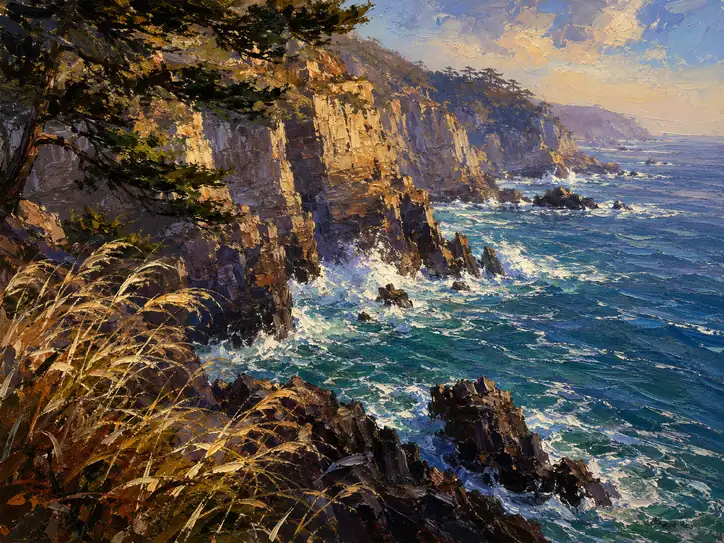 Gilded Sentinel of the Tide
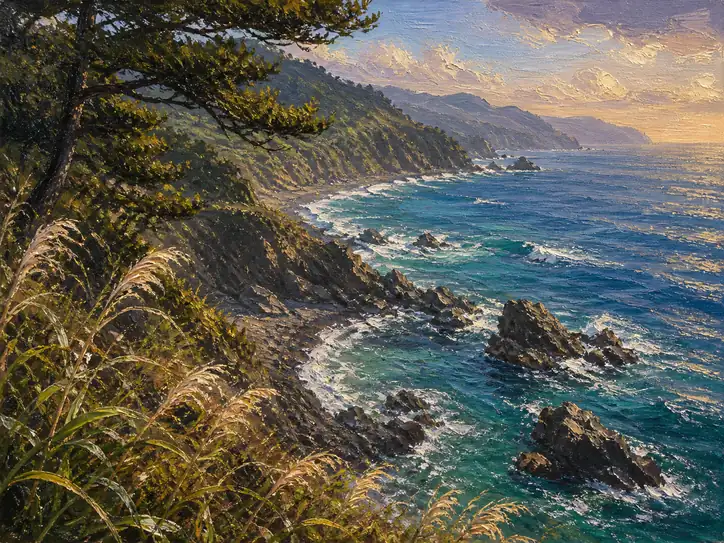 The Pulsing Threshold of the Golden Hour
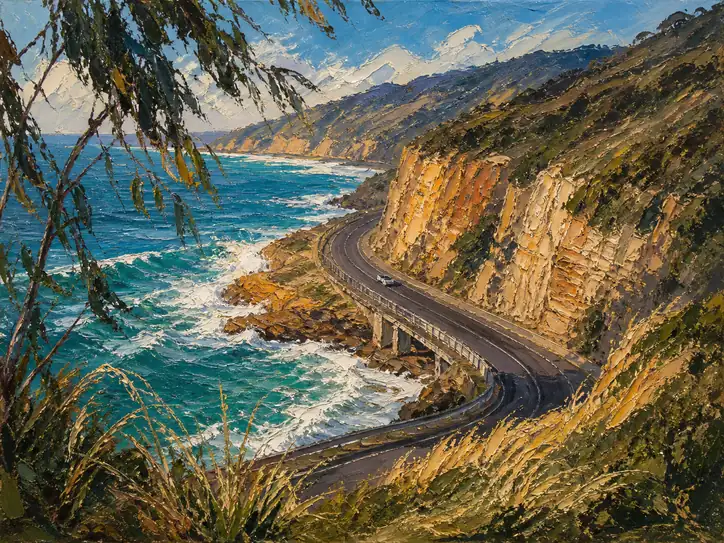 The Path to Infinite Horizons