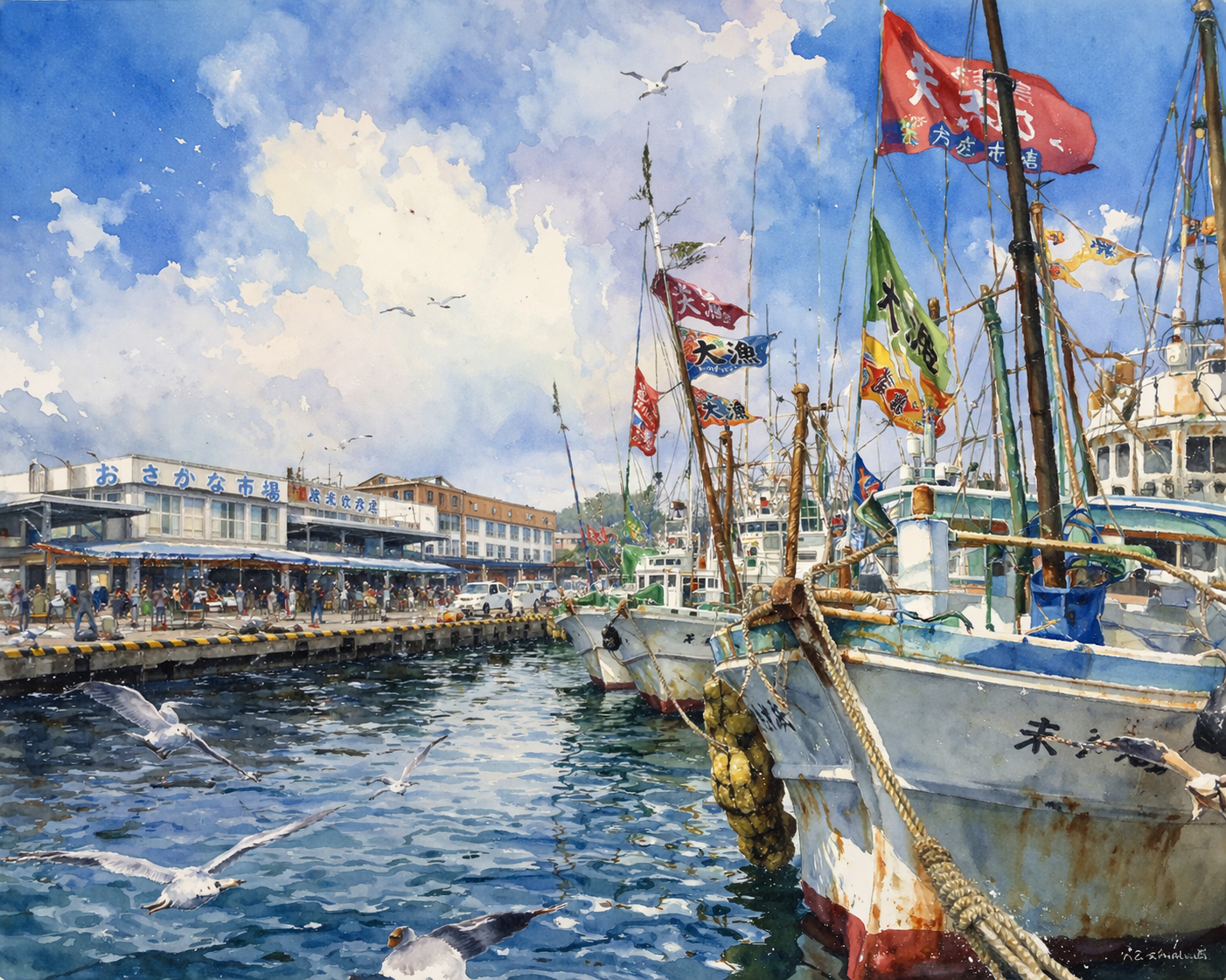
Rhythm of the Morning Tide
Critique
1. Introduction This watercolor painting depicts a lively scene at a Japanese fishing port, likely early in the morning. The work captures the vibrant energy of a local maritime community, centered around several fishing boats adorned with tradition "tairyo-bata" (large catch flags). The composition effectively balances the detailed maritime elements in the foreground with a vast, airy sky, creating a sense of openness and bustling activity. 2. Description In the foreground, the bow of a weathered fishing boat dominates the right side of the frame, its rigging and ropes rendered with meticulous detail. Multiple flags in red, green, and blue flutter from the masts of several vessels. To the left, a long building labeled "Fish Market" in Japanese characters stretches along the pier, where various figures and vehicles suggest a busy marketplace. Numerous seagulls are shown in mid-flight above the shimmering blue water of the harbor. 3. Analysis The artist demonstrates a mastery of the watercolor medium, utilizing its transparency to create a luminous sky and reflective water surfaces. The brushwork is precise in the architectural and mechanical details of the boats, while remaining fluid and expressive in the movement of the birds and clouds. A sophisticated use of atmospheric perspective is evident, as the distant buildings and hills fade into softer, paler tones, providing a convincing sense of depth to the harbor scene. 4. Interpretation and Evaluation The painting serves as an celebratory interpretation of coastal life and the industry that sustains it. The inclusion of the "tairyo-bata" flags adds a layer of cultural significance, symbolizing hope and prosperity for the fishermen. Technically, the work is outstanding for its ability to manage complex details without losing the overall cohesion of the light and atmosphere. The artist’s choice of a bright palette reinforces a positive, energetic evaluation of the subject. 5. Conclusion What begins as a focused observation of maritime hardware gradually expands into a broader appreciation for the rhythm of port life. This work succeeds in combining technical precision with atmospheric charm, offering a window into a specific cultural and economic environment. Ultimately, the painting stands as a refined example of contemporary watercolor, capturing the spirit of a working harbor with both clarity and poetic resonance.
Same Subcategory
 Solitary Beacon Above the Wild Shore
 Summer Echoes by the Bridge
Similar Artworks
 Tangled Ropes and Vibrant Memories
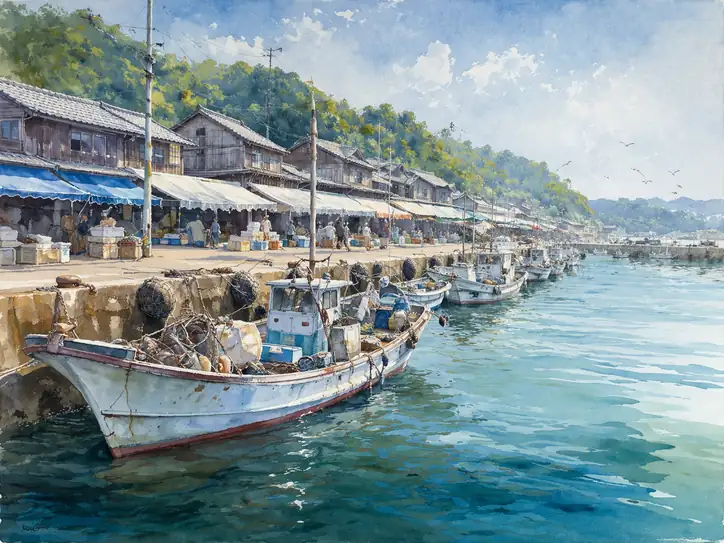 Whispers of the Working Harbor
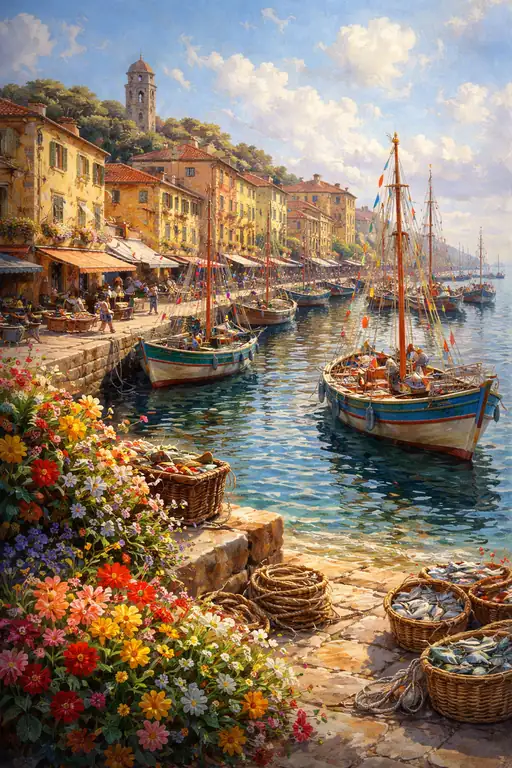 Sunlit Whispers of the Mediterranean Sea
 Golden Bloom by the Serene Shore
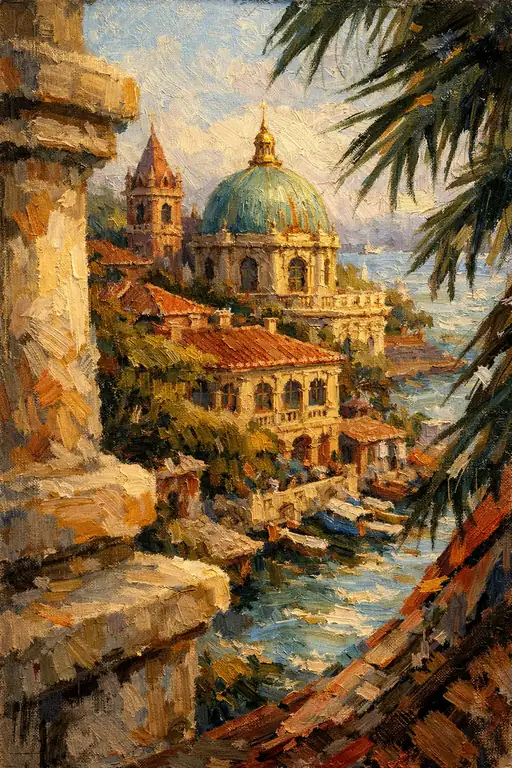 Symphony of Sunlit Terracotta
 Haven of the Sapphire Sea
 Voyage to the Earth’s Beating Heart
 Roar of the Indomitable Tide
 Pulse of the Azure Roar
 Unwavering Hope Amidst the Raging Seas