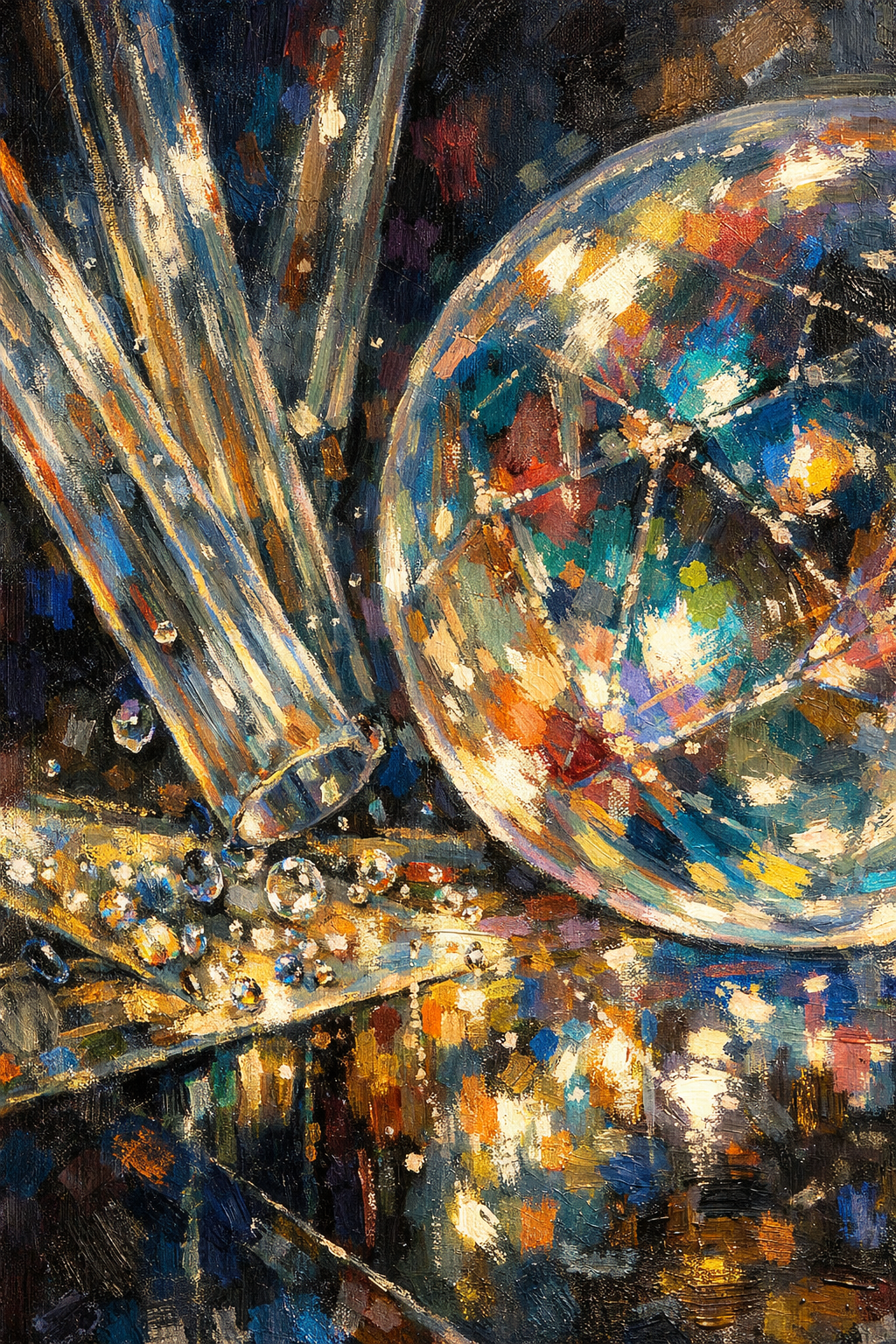
Prismatic Echoes of Light
Critique
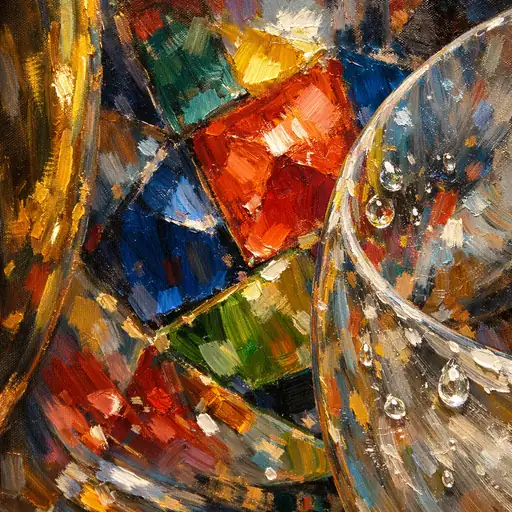
1. Introduction This extremely vibrant oil painting focuses on light passing through glass spheres and tubular objects and the resulting diffuse reflections of color. Abstract components and concrete textural depictions intersect, providing the viewer with a visual pleasure akin to looking through a kaleidoscope. The countless color spots scattered across the entire screen appear as an attempt to depict the particles of light themselves, creating a sense of constant flickering within the still frame. It is an ambitious work that seeks to capture the intangible existence of light through the accumulation of heavy paint. 2. Description A large circular sphere is positioned to the right of the center, with several tubular objects crossing diagonally on the left. In the foreground, circles resembling water droplets or small bubbles overlap, each reflecting the surrounding colors in a complex manner. The color composition is highly multicolored, with fine brushstrokes of yellow, orange, red, green, and brilliant white arranged against a deep blue and black background. The areas indicating light reflections are layered with thicker paint than their surroundings, emitting a physical radiance. 3. Analysis The formal characteristic lies in the coexistence of fine, pointillistic brushwork and a dynamic integrating composition. The geometric contrast created by the sphere's curves and the tubes' straight lines provides structural stability to the frame. Meanwhile, the arrangement of colors is extremely free, skillfully using complementary relationships to maintain high saturation throughout the screen and generate visual vibration. The thick application of the impasto technique is concentrated on the reflection points, bringing depth and intense light-dark gradations to the frame. 4. Interpretation and Evaluation This work aestheticizes the infinite colors and light energy hidden within common transparent objects. The descriptive power, which masterfully expresses the transparency of glass and the surface tension of water droplets using the contradictory medium of opaque paint, is astonishing, and the ability to control color is extremely high. From an original perspective, the piece is unique for transcending the framework of still life and depicting the phenomenon of light itself as a dramatic epic. The harmony between meticulous detail and overall splendor gives the work a celebratory value. 5. Conclusion Initially bewildered by the dazzling torrent of colors, one perceives a precise order based on the laws of light upon deeper observation. It is an excellent expression where paint as matter and light as phenomenon contend and merge at a high level. This piece visualizes the miracle named light, which is ubiquitous but often overlooked in our surroundings, through powerful formal aesthetics. Ultimately, this radiance-filled depiction vividly awakens our sensitivity to the minute beauties that color our daily lives.
Same Subcategory
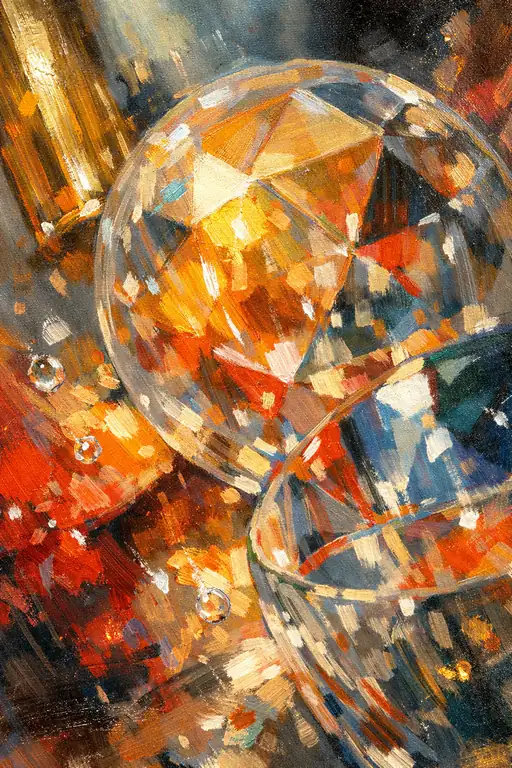 Luminous Fractures of a Waking Dream
 Tears of Light on the Wooden Sill
Similar Artworks
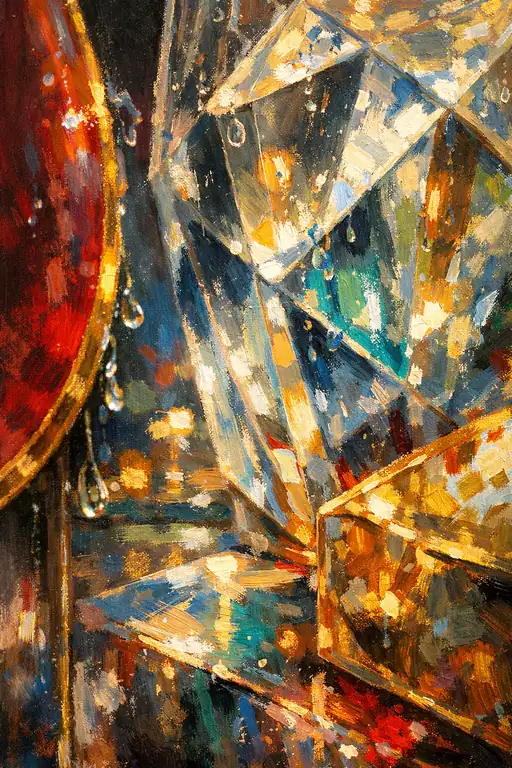 Echoes of a Fractured Dream: The Prismatic Heart
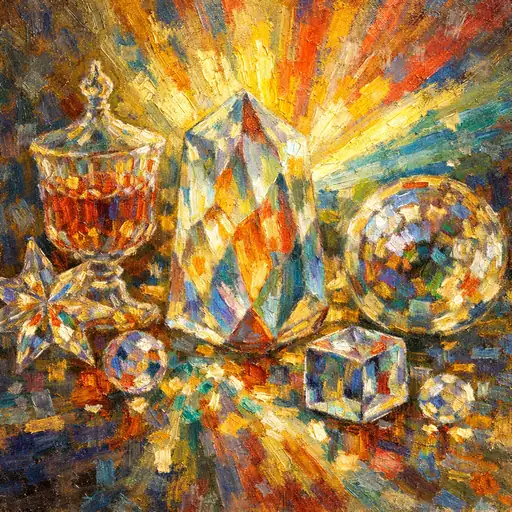 Prismatic Radiance: A Symphony of Refracted Light
 The Golden Ring and the Prism
 Prismatic Echoes in Crystal
 My World Reflected in a Single Droplet
 The Sphere of Luminous Dreams
 Reflections of Elegance
 Symphony of Refracted Light
 Kaleidoscope of Shattered Light
 A Labyrinth of Chromatic Glass