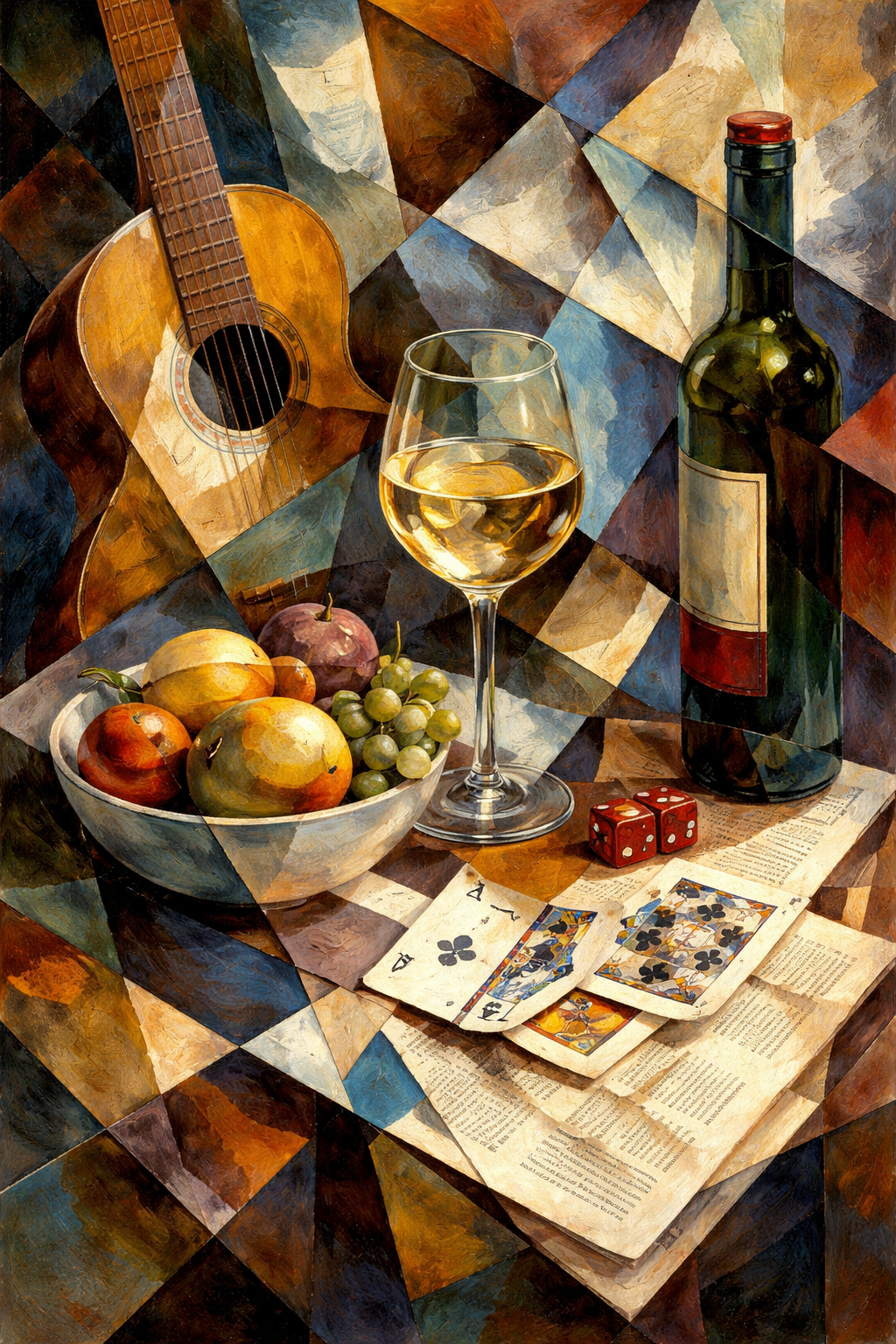
Recomposition of Stillness and Spirits
Critique
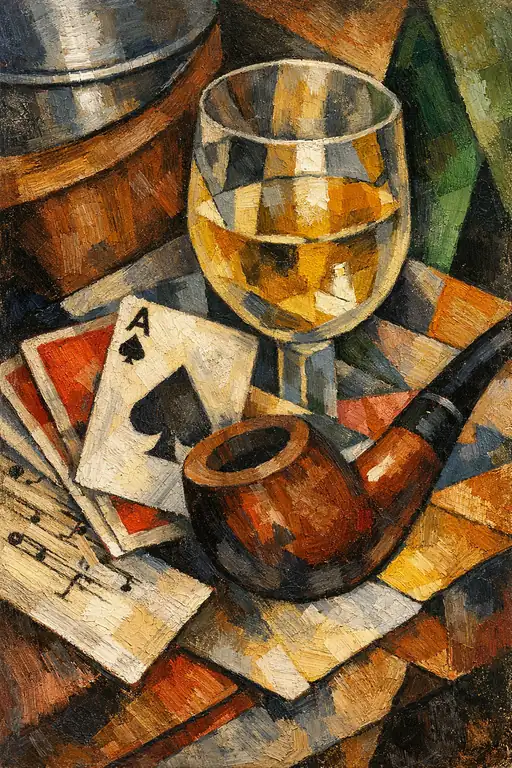
1. Introduction This artwork is an ambitious abstract still life that reconstructs everyday objects through a Cubist spatial framework. Traditional motifs—such as a guitar, a wine bottle, fruit, playing cards, and dice—are skillfully arranged within a fragmented, geometric background. Executed with precise oil techniques, each element maintains its three-dimensional volume while functioning as part of a two-dimensional decorative pattern. The viewer experiences a multilayered intersection of time and space within the seemingly static world of still life objects. 2. Description In the center of the composition sits a wine glass filled with white wine, flanked on the left by a bowl of fruit and behind by the body of an acoustic guitar. To the right stands a labeled wine bottle, while the foreground is scattered with several playing cards, two red dice, and sheets of paper resembling musical scores or newsprint. The background consists of a patchwork of brown, blue, and white triangles that intersect and overlap, simultaneously fragmenting and reuniting the physical forms of the objects in front of them. 3. Analysis The defining structural feature of this work is the high level of tension between representational detail and abstract background. While the reflections and textures of each motif are rendered with clarity, the geometric patterns of the background detach them from physical continuity, converting them into pure formal elements. The color palette is dominated by a muted, sepia-toned base, allowing the golden hue of the wine and the vivid red of the dice to serve as effective visual accents. The use of multiple diagonal lines introduces a dynamic rhythm to the typically serene genre of still life. 4. Interpretation and Evaluation This painting represents a masterful fusion of homage to classical still life and contemporary abstract expression. Beyond the mere deconstruction of form, the fragmentation of symbols associated with leisure, art, and pleasure evokes a "Vanitas"-like depth, reminding the viewer of the fleeting and multifaceted nature of life. The artist's ability to balance realistic technique with structural abstraction is remarkable, and the meticulous attention to detail ensures that the work offers new discoveries upon every viewing. 5. Conclusion Ultimately, the piece is a masterpiece that brings multi-perspective interpretation and modern order to an enduring subject. Within the fragmented space, objects with a solid presence breathe quietly, establishing a rich dialogue between form and meaning. By inheriting traditional aesthetics while re-envisioning the world through a unique visual language, the artist has produced a high-quality abstract expression that is both profound and captivating.
Same Subcategory
Similar Artworks
 Harvest of the Golden Light
 Citrus Illusions on a Geometric Plate
 Symphony of the Segmented Mind
 Geometric Citrus Geometry
 Whispers of the Cobalt Glass
 A Broken Melody Lingers
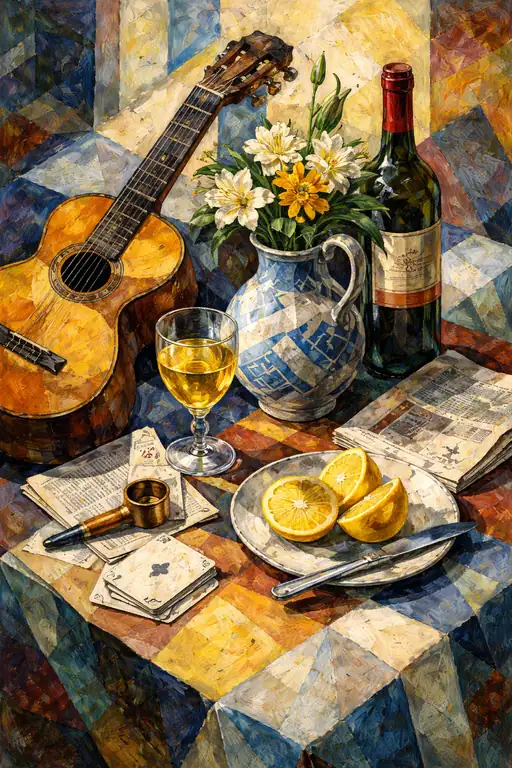 A Symphony of Fragmented Leisure
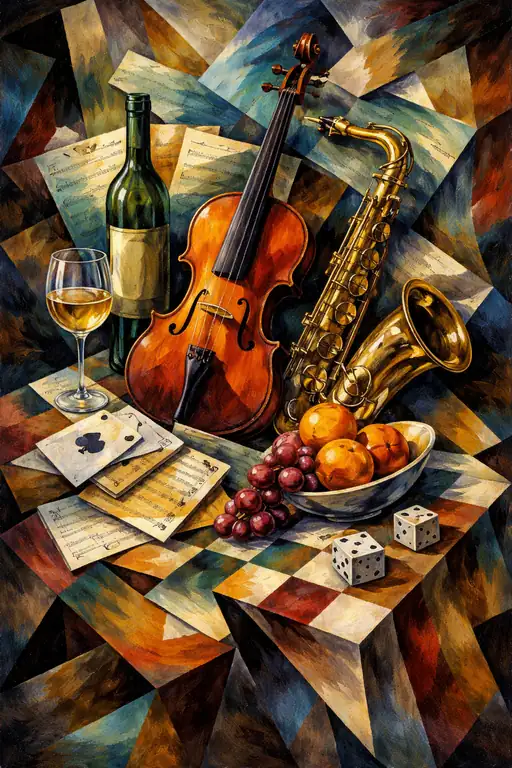 The Fragmented Melody of Leisure
 Fractured Memories of a Quiet Evening
 Geometry of the Soul's Prism