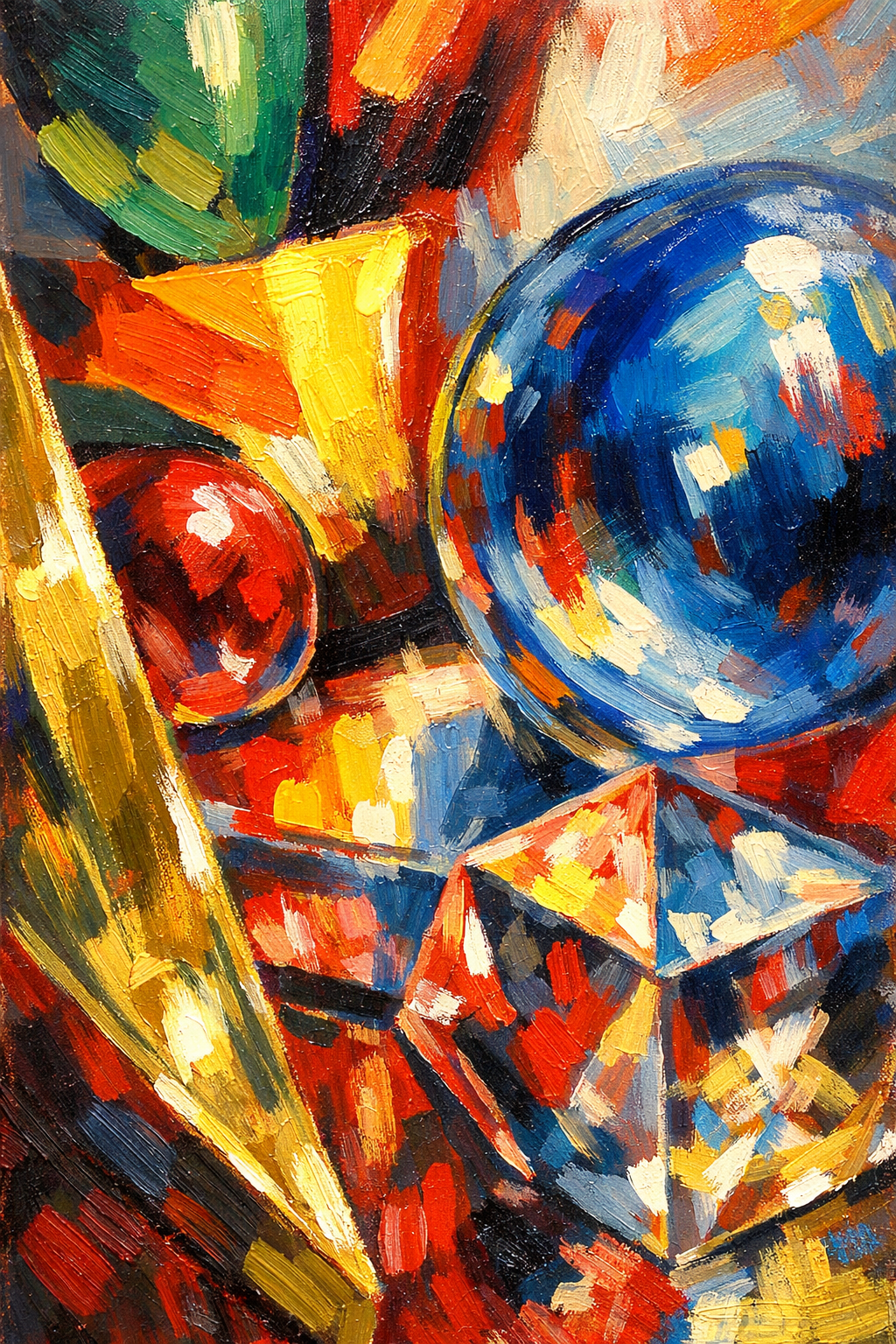
Collision of Primal Echoes
Critique
1. Introduction This piece is an expressionist abstract work where geometric forms and intense colors intersect violently. Primitive shapes such as spheres and polyhedrons are arranged on the canvas, rendered dynamically with thick, bold brushwork. Pushing the purity of color and the energy of brushstrokes to the forefront, the work stirs the viewer's emotions through visual impact, presenting the inherent vitality of form itself. It is an ambitious composition that attempts to dismantle and reconstruct traditional shapes. 2. Description In the upper right of the canvas, a large, vivid blue sphere is positioned, while sharp, yellow elongated forms protrude from the lower left. Near the center, a red sphere and a complex crystal-like polyhedron are combined, each expressed as a collection of short, powerful strokes. The entire composition, including the background, centers on the primary colors of red, yellow, and blue, interspersed with complementary greens and oranges. The paint is applied so thickly that it rises from the surface, with individual brushstrokes functioning as independent units of light. 3. Analysis The formal characteristics lie in the emphasis on texture through thorough impasto techniques and the geometrization of forms. Rather than being defined by outlines, each form dictates its boundaries through the collision of adjacent blocks of color. Regarding color, high-value highlights of yellow and white are placed throughout, giving the canvas a flickering movement of light. The composition, where vertical, horizontal, and diagonal lines intersect complexly, brings an explosive sense of motion and rhythm to the stationary subject matter. 4. Interpretation and Evaluation The work can be interpreted as an effort to reduce the essence of matter to pure elements of form and color, depicting their interaction. Spheres and polyhedrons symbolize cosmic order, while the rough brushwork seems to express the primordial chaos lurking within that order. By abandoning figurative representation, the artist's descriptive power succeeds in maximizing the emotional force of color. The fusion of original textural expression and traditional color-plane composition is highly praised as a legitimate evolution of abstract expressionism. 5. Conclusion While initially captivated by the unrestrained use of color, detailed observation reveals how strictly the arrangement of each form relies on a precise balance. The piece transcends mere visual pleasure, embodying the fusion of materiality and spirituality inherent in the medium of painting. In conclusion, this work is an excellent expression that awakens fundamental human senses through a dialogue between color and form. The chaotic strength of the first impression eventually sublimates into an experience of ordered beauty.
Same Subcategory
 Labyrinth of Golden Sparks
Similar Artworks
 Dynamic Symphony of Shapes
 Composition of Geometry and Primary Colors
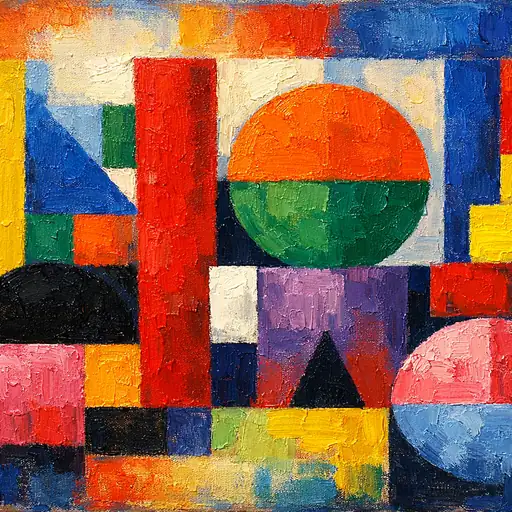 Symphony of the Primal Spectrum
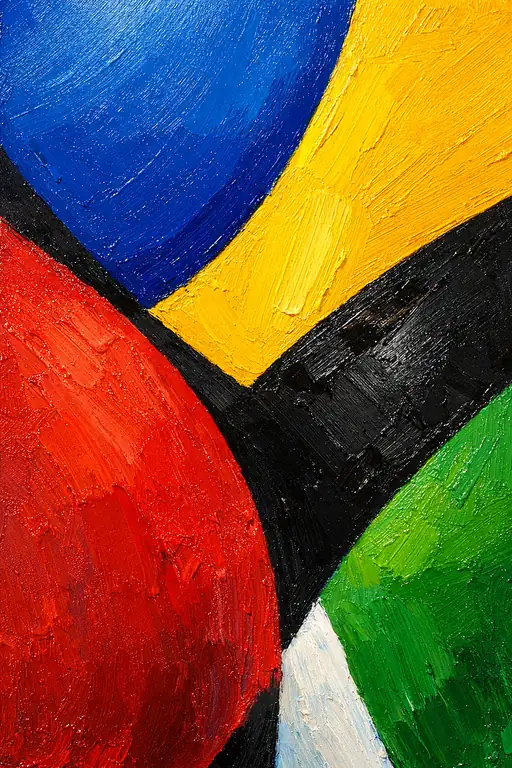 The Bold Pulse of Colors
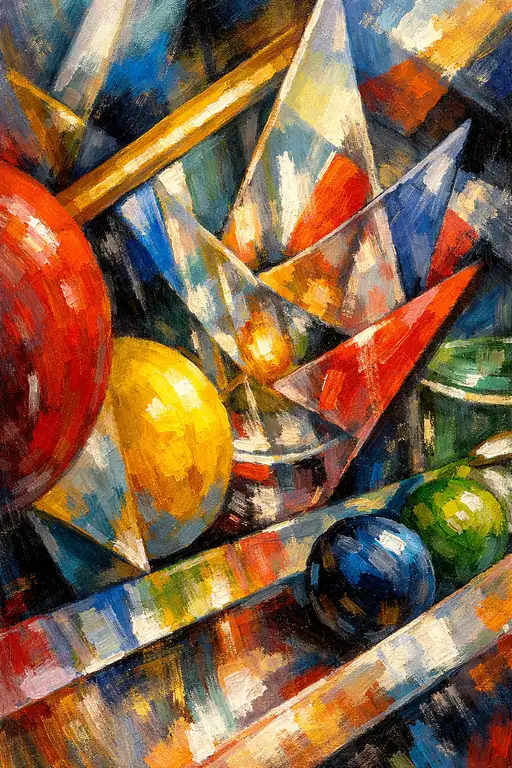 Convergence of Prismatic Dreams
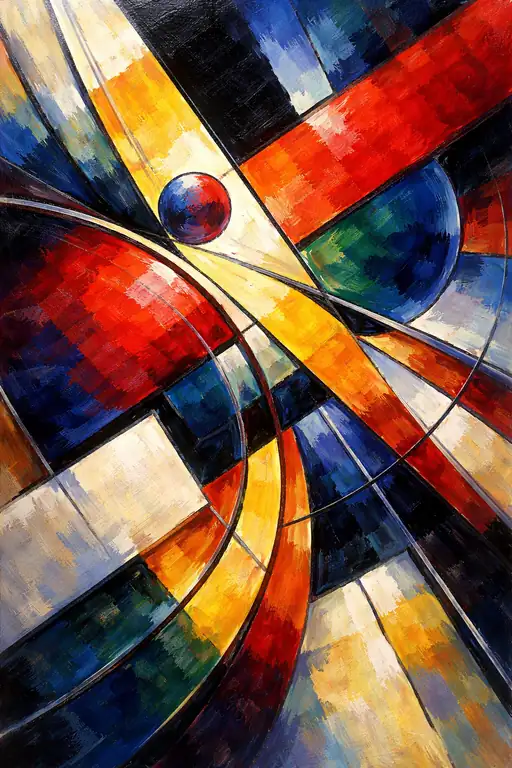 Symphony of the Vanguard
 Rhythm of the Prism Bubbles
 Whispers in Blue Velvet
 Intersection of Colors: Modern Abstract Painting Woven by Dynamic Strokes
 Colorful Abstract Geometry of Triangles