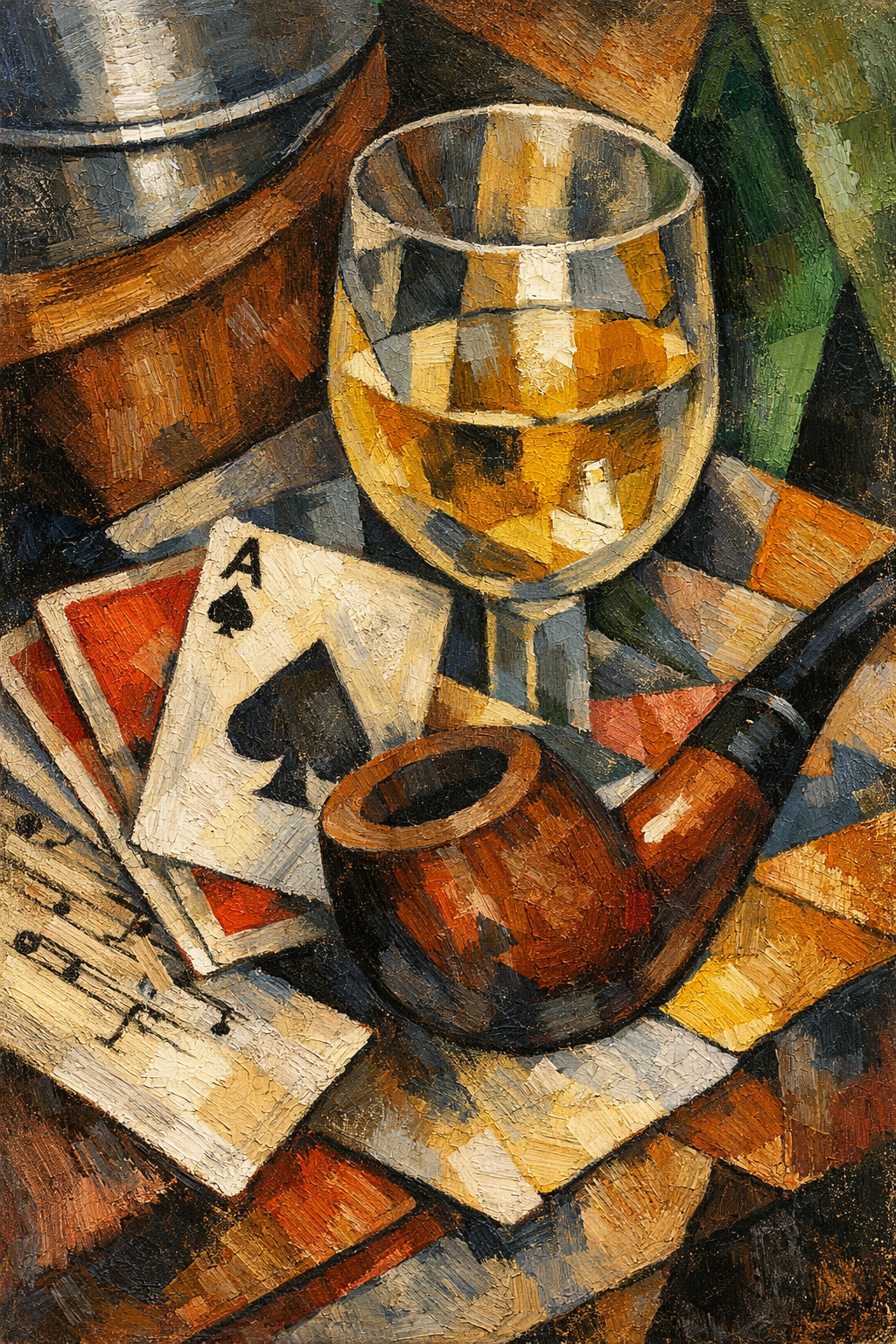
Fractured Memories of a Quiet Evening
Critique
1. Introduction This painting is a sophisticated still life that draws heavy inspiration from the principles of Analytic Cubism. The work deconstructs everyday objects into a complex web of geometric planes, challenging the viewer窶冱 traditional perception of space and form. Through this fragmented lens, the artist explores the relationship between mundane items and the abstract structure of the canvas, creating a intellectually stimulating visual experience. 2. Description The composition features a variety of objects, including a wine glass filled with an amber liquid, a classic wooden pipe, and several playing cards, prominently displaying the Ace of Spades. Beneath these items, what appears to be sheet music is partially visible, its staff lines and notes integrated into the geometric background. The entire scene is rendered with small, mosaic-like brushstrokes that break down the surfaces of the objects into faceted tiles of color and light. 3. Analysis The artist utilizes a limited palette of earth tones窶俳chre, burnt sienna, and deep browns窶俳ffset by subtle greens and grays. This choice focuses the viewer窶冱 attention on the structural interplay of lines and planes rather than on realistic coloration. The perspective is intentionally flattened, with the objects appearing to overlap and merge into the surrounding space. The rhythmic repetition of the tiling technique creates a sense of unity across the diverse elements of the still life. 4. Interpretation and Evaluation This work can be interpreted as a meditation on the deconstruction of reality and the multifaceted nature of observation. By presenting objects from multiple angles simultaneously, the artist captures the complexity of human vision and memory. The technical execution of the tiling effect is meticulous, demonstrating a disciplined approach to form and texture. The piece successfully bridges the gap between representational art and pure abstraction, showcasing a high degree of originality. 5. Conclusion In summary, the painting is a compelling example of how traditional subjects can be revitalized through a modern, structural approach. While the initial impression may be one of chaotic fragmentation, a more careful analysis reveals a carefully balanced and rhythmic composition. The artist窶冱 ability to maintain the identity of the objects while subjecting them to such radical deconstruction is a significant achievement that resonates with the history of modern art.
Same Subcategory
 Caress of the Evening Sun's Lace
 The Chaos from Which Dreams Are Born
Similar Artworks
 A Symphony of Fragmented Leisure
 Shattered Light and Citrus Dreams
 Geometry of the Soul's Prism
 Harvest of the Golden Light
 Luminous Whispers in Glass
 Echoes of a Quiet Afternoon: The Pitcher and Scattered Fruit
 Heart of Creation
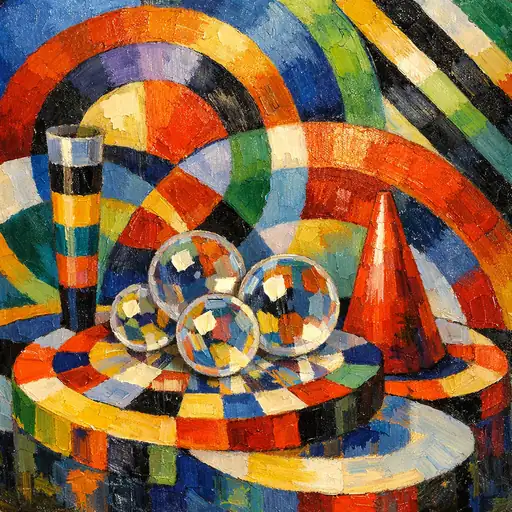 Mosaic Dreams of Spheres
 Shattered Reality: A Vibrant Dance of Cubes and Bottles
 Vintage Scents and Weathered Wood