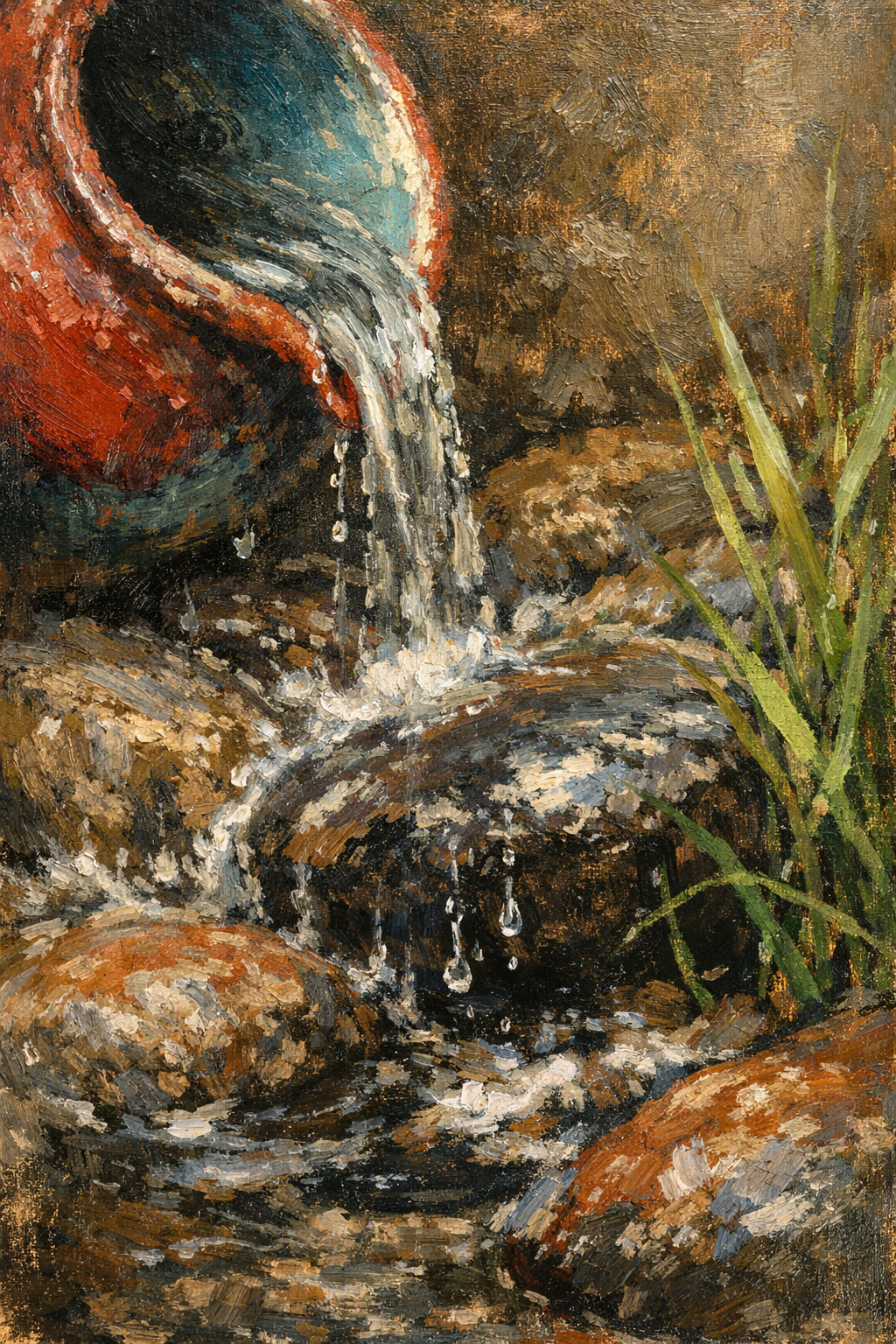
Earth's Enduring Flow
Critique
1. Introduction This oil painting presents a focused and textural exploration of water cascading from an earthen vessel. The composition centers on a tilted red clay pot from which a steady stream of water flows over rounded river stones. Through a heavy application of paint and a warm, earthy color palette, the artist captures a sense of tactile reality and elemental movement. The work emphasizes the raw, physical qualities of its subjects, elevating a simple natural occurrence into a compelling visual study. 2. Description A large, reddish-orange pot is positioned in the upper left, its interior showing hints of blue and dark shadow. Water pours from its rim in a series of thick, white and translucent strokes, splashing onto dark, wet rocks below. Several blades of green grass rise from the right side, providing a vertical contrast to the diagonal flow of the water. The background is a dark, indistinct brown and ochre, rendered with broad, textured brushstrokes that suggest a cave or a shaded stream bank. 3. Analysis The artist utilizes a strong diagonal composition, following the path of the water from the upper left to the lower center. The use of the impasto technique is particularly effective here, as the thick paint physically mimics the volume and turbulence of the falling water. Color is used to convey temperature and light, with the warm tones of the clay and rocks contrasting with the cool, bright highlights of the water. The varied textures窶杷rom the rough pot to the smooth stones and sharp grass窶把reate a rich sensory experience for the viewer. 4. Interpretation and Evaluation This piece can be interpreted as a meditation on the nourishing and transformative power of water within a terrestrial context. The act of pouring suggests both a natural cycle and a deliberate human or divine intervention, though no figure is present. Technically, the painting is successful in its bold handling of oil media, effectively using texture to define form and motion. The work demonstrates high originality in its close-up, visceral approach to the subject, although the background could benefit from slightly more spatial definition. 5. Conclusion What initially appears as a straightforward still life in a natural setting becomes a powerful demonstration of the expressive potential of paint. The synthesis of light, shadow, and heavy impasto creates a work that is both physically present and evocative of a specific atmosphere. The vessel remains a central, stabilizing element amidst the fluid movement of the water. Ultimately, the painting offers a robust and engaging look at the interaction between solid matter and liquid energy.
Same Subcategory
Similar Artworks
 Warmth in a Rustic Bowl
 Sanctuary of the Silent Circle
 Serenade of the Flowing Stream
 Symmetry in Pine and Amber
 The Ember's Core
 The Vigorous Pulse of Life Pouring from Timeless Brass
 Whispers of Stone: The Endless Patience of Water
 Whispers of the Mossy Stream
 Vibrant Veins of the Woodland
 Eternity in a Waterfall's Embrace