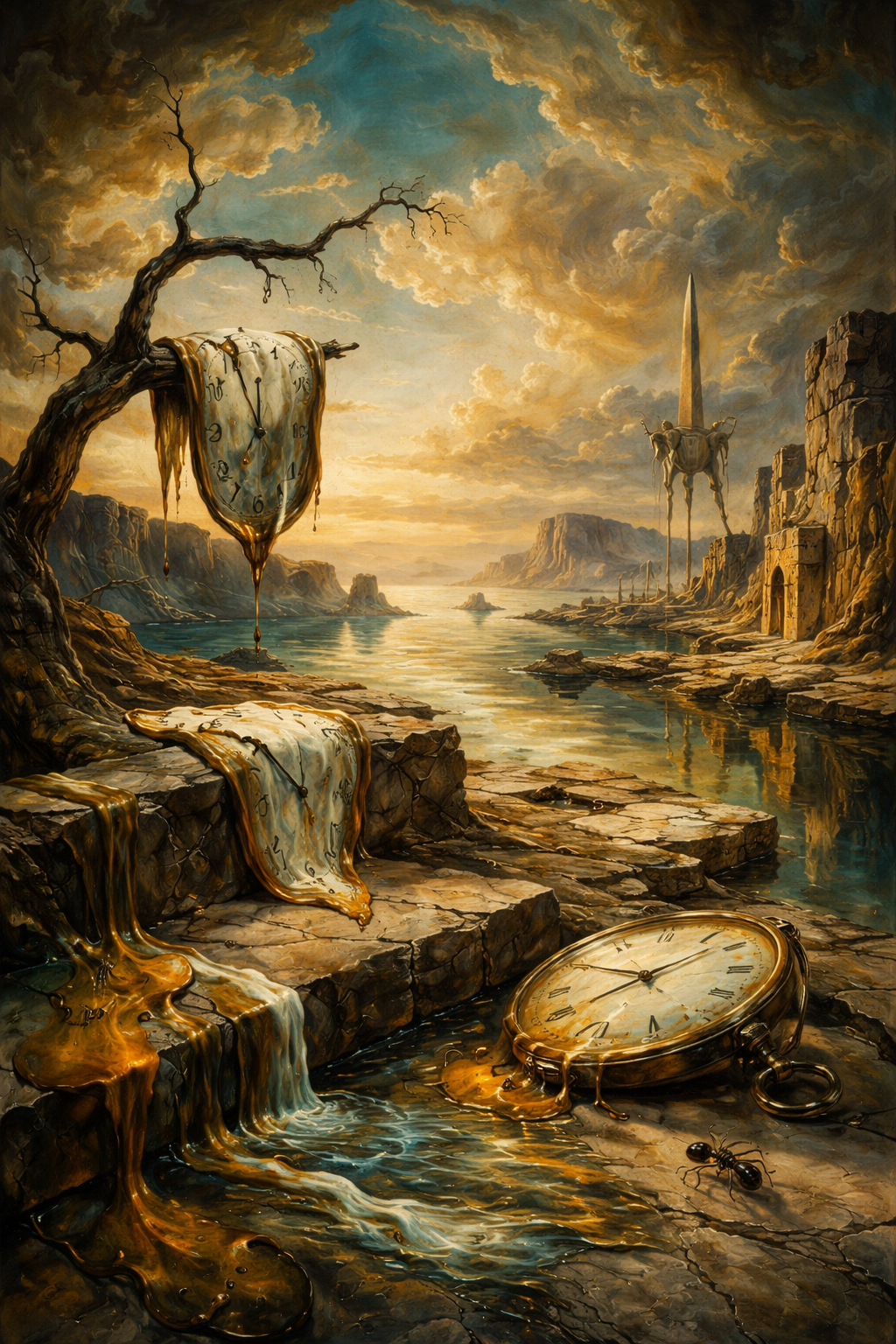
Tears of the Melting Clocks
Critique
1. Introduction This surrealist landscape explores the fluidity of time and the dissolution of reality within a dreamlike environment. The work draws heavily upon the traditions of surrealism, presenting a series of paradoxical elements that challenge the viewer's perception of stability and permanence in a desolate yet luminous setting. 2. Description The composition features several melting clocks draped over a withered, leafless tree branch and rugged stone steps. In the foreground, a golden pocket watch lies on the cracked earth, with a single ant crawling near its softening edge. A distant, spindly-legged structure carrying an obelisk stands near a calm body of water under a dramatic, cloud-filled sky illuminated by a low sun. 3. Analysis The artist employs a deep linear perspective that leads the eye from the intricate details of the foreground toward the ethereal structures in the distance. The warm, golden light of the horizon creates a sharp contrast with the cool, dark tones of the shadows and the rocky cliffs. The smooth, liquid textures of the clocks provide a stark visual counterpoint to the rough, jagged surfaces of the surrounding landscape. 4. Interpretation and Evaluation By depicting mechanical objects in a state of decay or liquefaction, the work serves as a powerful metaphor for the subjective and elusive nature of time. The technical skill is evident in the meticulous rendering of the metallic sheen and the atmospheric depth of the sky. The integration of iconic surrealist motifs demonstrates a sophisticated understanding of visual symbolism and emotional resonance. 5. Conclusion An initial sense of familiarity with surrealist themes gradually gives way to an appreciation for the specific atmospheric tension and technical precision of the piece. The painting successfully captures a moment of transcendental stillness, inviting a profound reflection on the inevitable passage of time and the fragility of the physical world.
Same Subcategory
Similar Artworks
 The Crystal Heart of the Enchanted Woods
 The Key to the Floating Sky
 Moonlit Melody on Silent Waters
 Twilight at the Hidden Haven
 Golden Echoes of the Karst River
 The Peacock's Garden of Golden Falls
 The Silent Rings of the Eternal Void
 Leviathan's Slumber Above the Golden Peaks
 Echoes of a Future Past
 Cosmic Pulse of the Neon Stardust