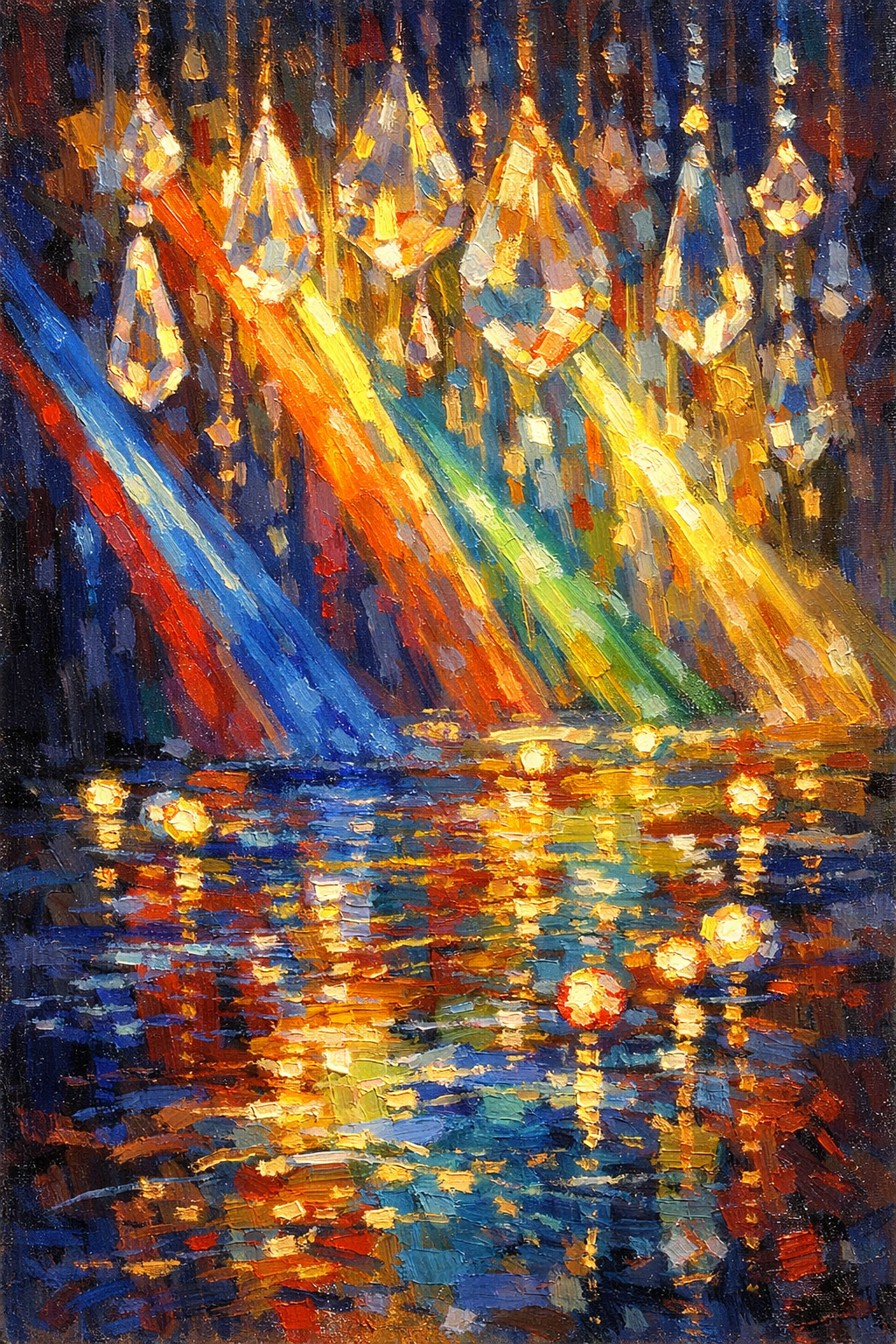
Tears of the Prismatic Night
Critique
1. Introduction This painting is an expressive abstract work that focuses on the interplay of hanging light sources and their vibrant reflections on a dark surface. Several teardrop-shaped pendants or crystals descend from the top of the frame, emitting powerful beams of primary and secondary colors. The composition is highly dynamic, relying on strong diagonal lines and a rich, textured application of paint to create a sense of radiant energy. 2. Description In the upper half of the canvas, six glowing pendants are arranged against a deep indigo background. Each pendant projects a distinct beam of light窶排ed, blue, orange, green, and yellow窶杯hat slices diagonally toward the lower left. The bottom half of the painting depicts a dark, reflective surface, possibly water, which breaks the light into a chaotic yet beautiful array of shimmering dots and dashes. The heavy use of impasto creates a physical relief on the canvas, emphasizing the intensity of the light. 3. Analysis The composition is structured around the strong diagonal movement of the light beams, which provides a sense of speed and direction. The color palette is bold and high-contrast, juxtaposing the warm oranges and yellows against the cool, dark blues of the background. The artist窶冱 technique is characterized by short, rhythmic brushstrokes and the use of a palette knife, which adds a tactile quality to the reflections. This approach effectively translates the ephemeral quality of light into a solid, tangible form. 4. Interpretation and Evaluation This work can be seen as a celebration of pure color and the transformative power of light in the darkness. By abstracting the light sources, the artist emphasizes the emotional impact of the colors rather than a literal depiction of a scene. The technical execution is confident, with the thick paint layers adding a sense of weight and importance to each stroke. The balance between the structured upper portion and the fragmented lower portion creates a compelling visual tension that holds the viewer's attention. 5. Conclusion In conclusion, the painting is a vibrant exploration of optical phenomena and abstract expressionism. The initial impression of a simple light display develops into a deeper appreciation for the complex textures and the rhythmic organization of the colors. It is a highly effective work that manages to capture the fleeting brilliance of light in a permanent, physical medium.
Same Subcategory
Similar Artworks
 The Rhythm of the Rainbow
 Festive Sparkle Orbs
 Symphony of the Earth's Core
 Swirling Illusion of Geometric Forms and Light
 Molecular Cosmos in the Void
 Resonance of Prismatic Silence
 Dance of the Distorted Spheres
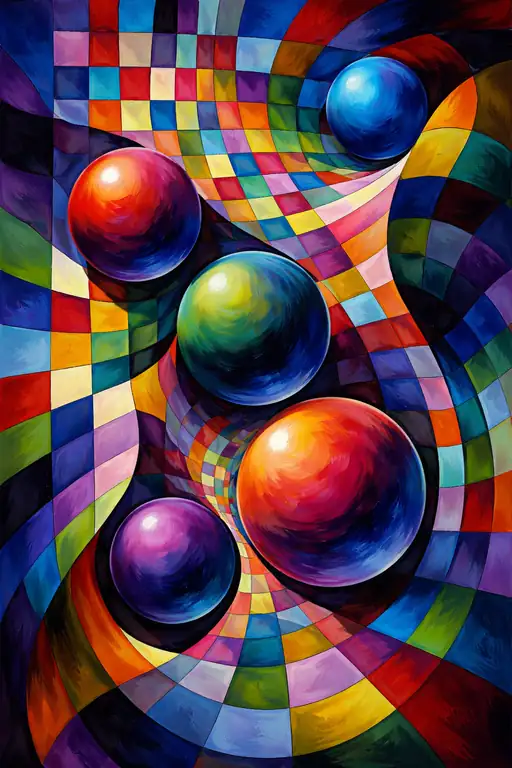 Floating Orbs on a Warped Horizon
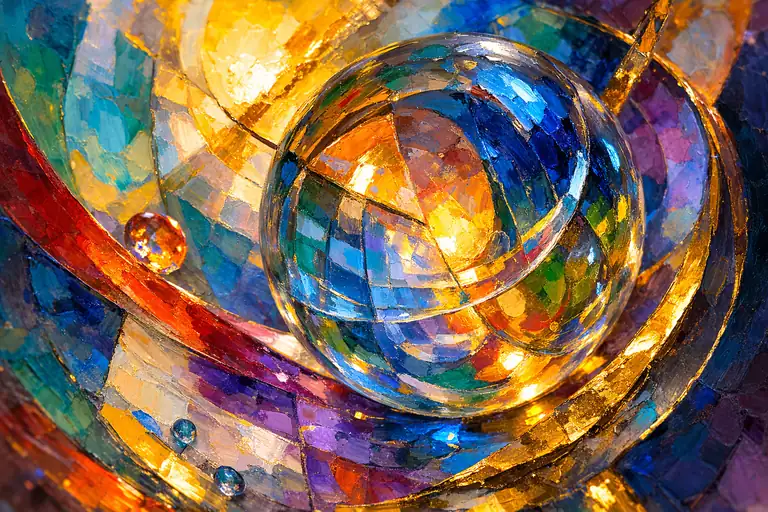 Cosmic Symphony in Sphere
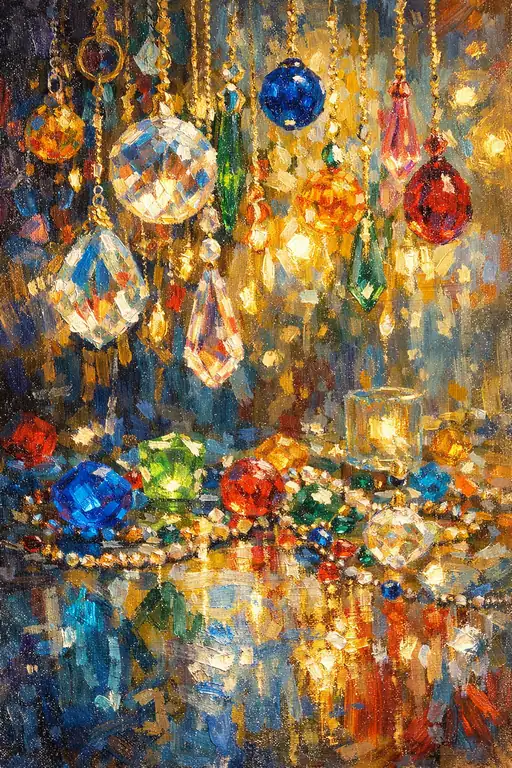 Echoes of a Jeweled Festivity