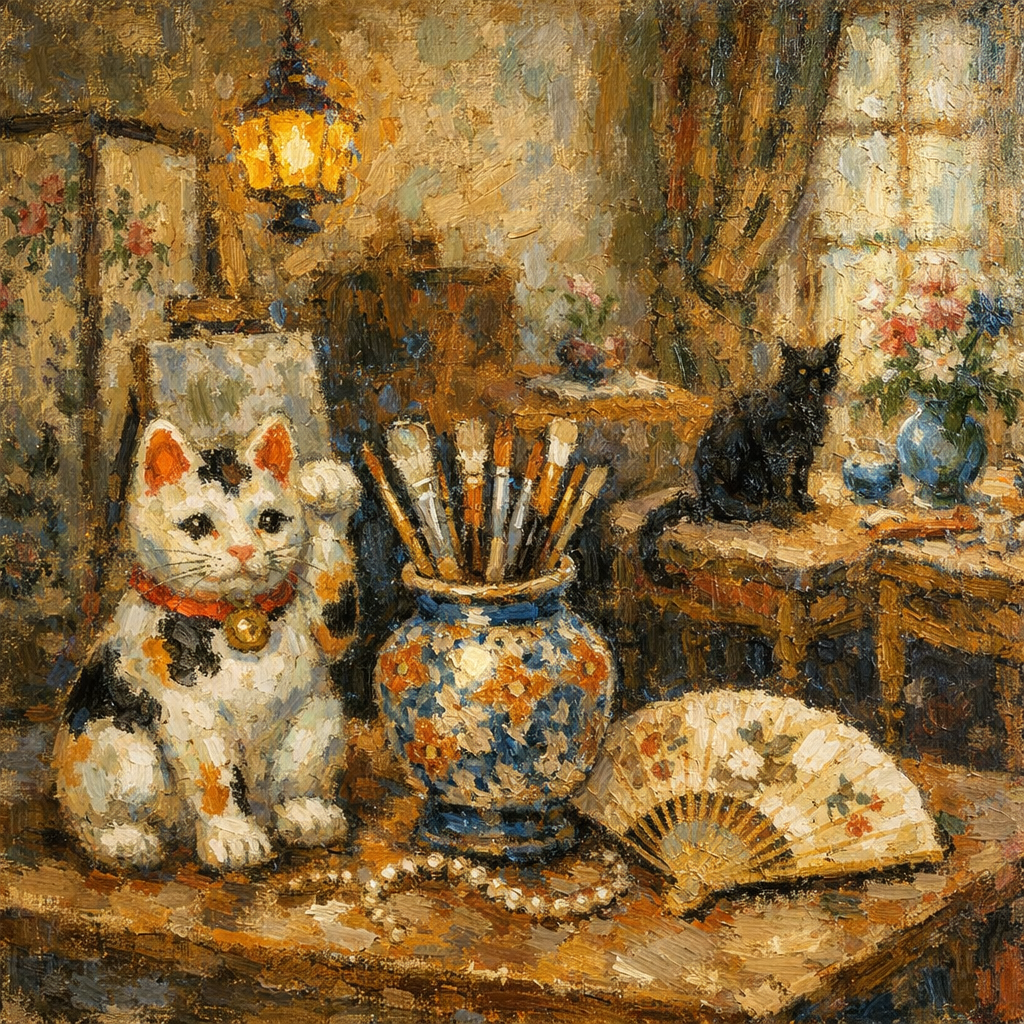
The Feline Muse of the Amber Studio
Critique
1. Introduction This oil painting presents a dense and evocative still life arrangement within what appears to be an artist's studio. The composition is centered around a collection of objects that blend traditional Japanese motifs with the hallmarks of a European painterly tradition. This work immediate attracts the viewer with its rich texture and warm, amber-toned lighting that saturates the interior space. It serves as a study of light and material, inviting the eye to explore a variety of surfaces and symbolic items arranged on a wooden table. 2. Description The foreground is dominated by a calico Maneki-neko, its raised paw greeting the viewer alongside a blue and orange floral vase filled with an assortment of brushes. Next to these, a white folding fan decorated with delicate floral patterns rests near a string of pearls. In the mid-ground, a black cat sits quietly on a secondary table, its dark silhouette providing a stark contrast to the bright window and a vase of flowers in the background. A glowing lantern hangs above the scene, casting a golden hue over the entire room, while a screen and a canvas add to the studio atmosphere. 3. Analysis The artist employs a heavy impasto technique, where thick layers of paint create a tactile surface that emphasizes the physical presence of each object. The color palette is primarily warm, dominated by golds, ochres, and oranges, which are balanced by the cool blues of the ceramic vases. Lighting plays a crucial role in the work, emanating from both the lantern and the unseen window to create a sense of depth and three-dimensionality. The brushwork is energetic and visible, giving the static objects a dynamic and living quality that keeps the viewer's gaze moving. 4. Interpretation and Evaluation This work is a successful fusion of cultural symbols and impressionistic techniques, creating a space where the exotic and the everyday coexist. The inclusion of the Maneki-neko and the fan suggests a deep appreciation for Japanese aesthetics, while the studio setting points to the universal nature of the creative process. The technical execution is exceptional, as the artist manages to convey different textures窶把eramic, fur, wood, and fabric窶杯hrough a consistent and bold application of paint. The overall harmony of the composition and the warmth of the lighting evoke a sense of quiet contemplation and artistic inspiration. 5. Conclusion Ultimately, the painting is a masterful exploration of domestic tranquility and the richness of a personal environment. The initial impression of a crowded table transforms into a realization of a carefully curated sanctuary of objects and memories. This piece demonstrates how light and texture can elevate common items into subjects of profound beauty and significance. It stands as a testament to the artist's ability to create a world that is both physically tangible and emotionally resonant.
Same Subcategory
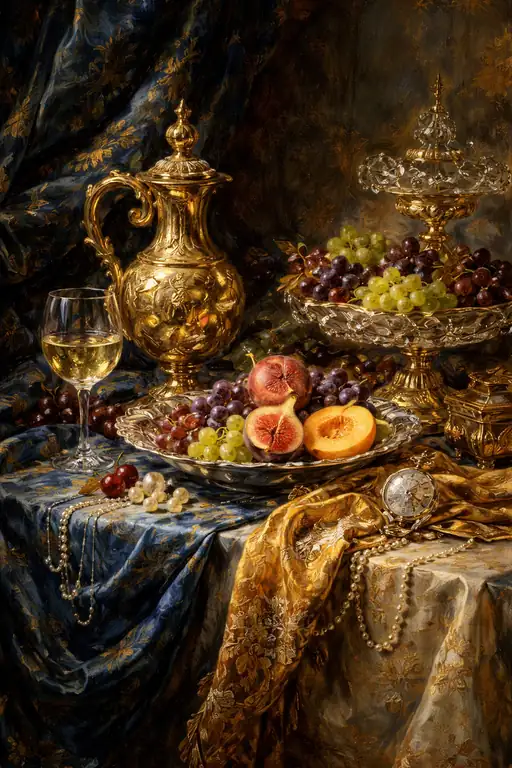 Sweet Bounty of the Harvest
Similar Artworks
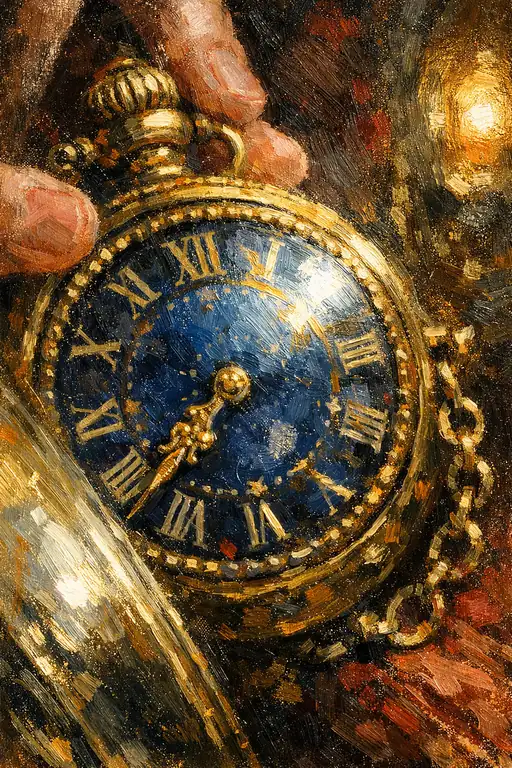 Golden Pulse in the Abyss of Time
 Holding Time Hostage
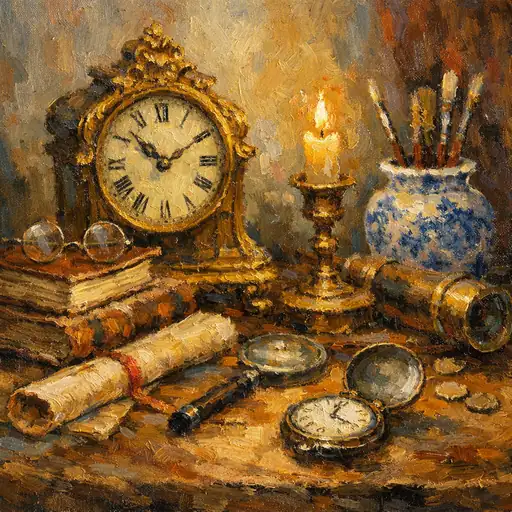 Whispers of the Golden Hour
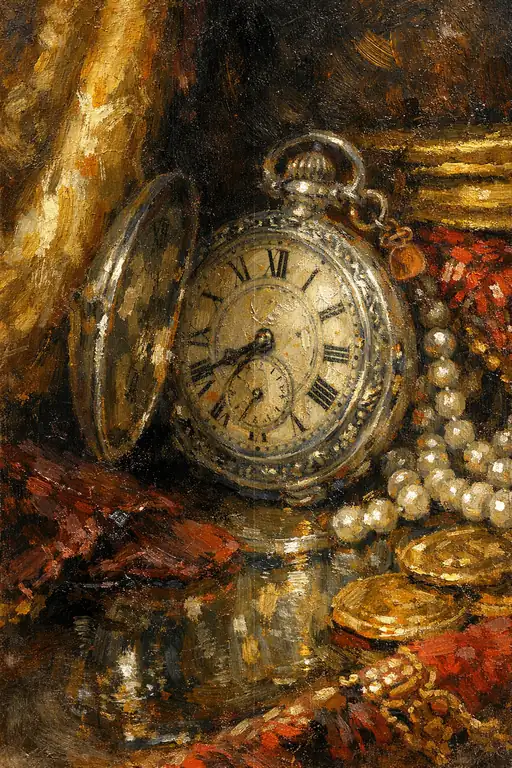 Echoes of Forgotten Time
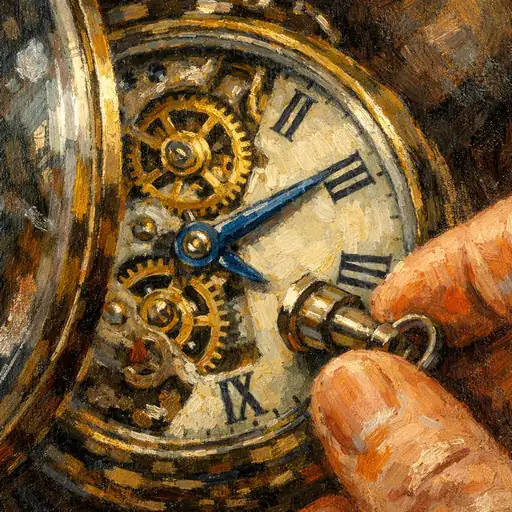 Heartbeats of the Golden Mechanism
 The Vanitas Glow: A Silent Ode to Ephemeral Wealth
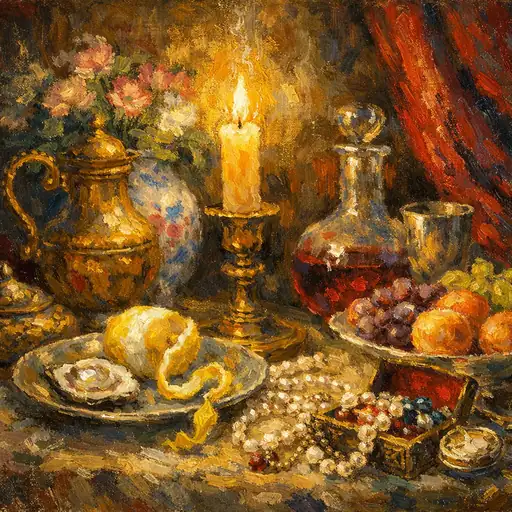 Ephemeral Grandeur of the Golden Age
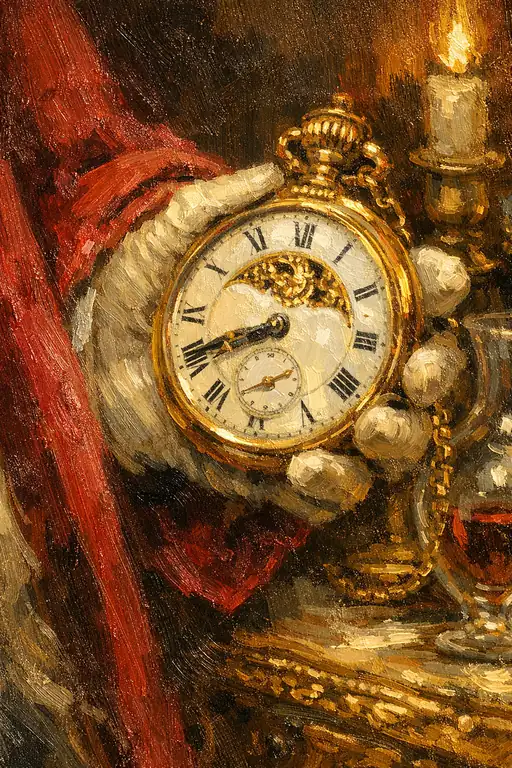 The Elegant Weight of Time
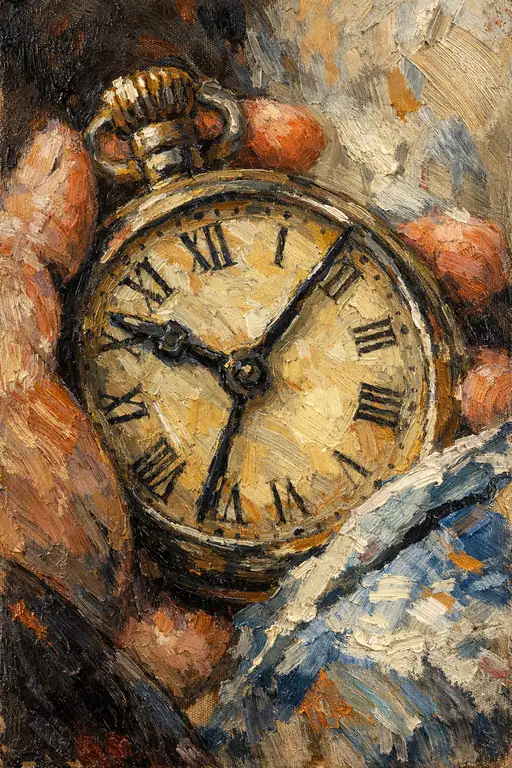 Holding the Weight of Painted Time
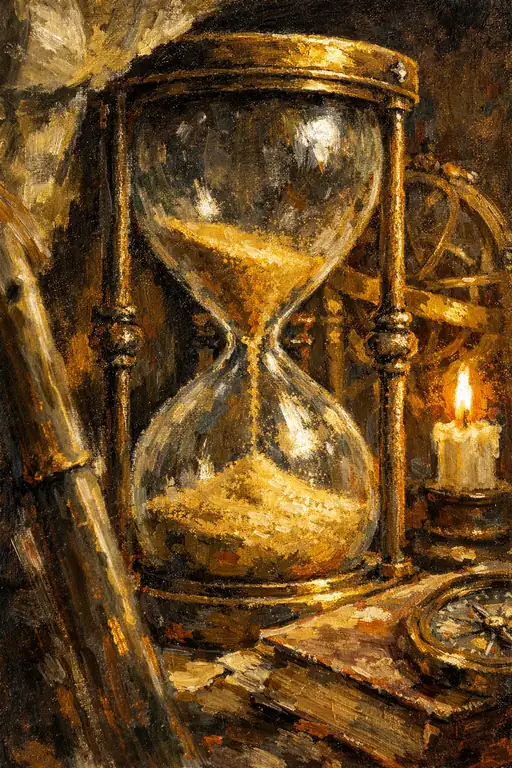 Echoes in the Falling Sand