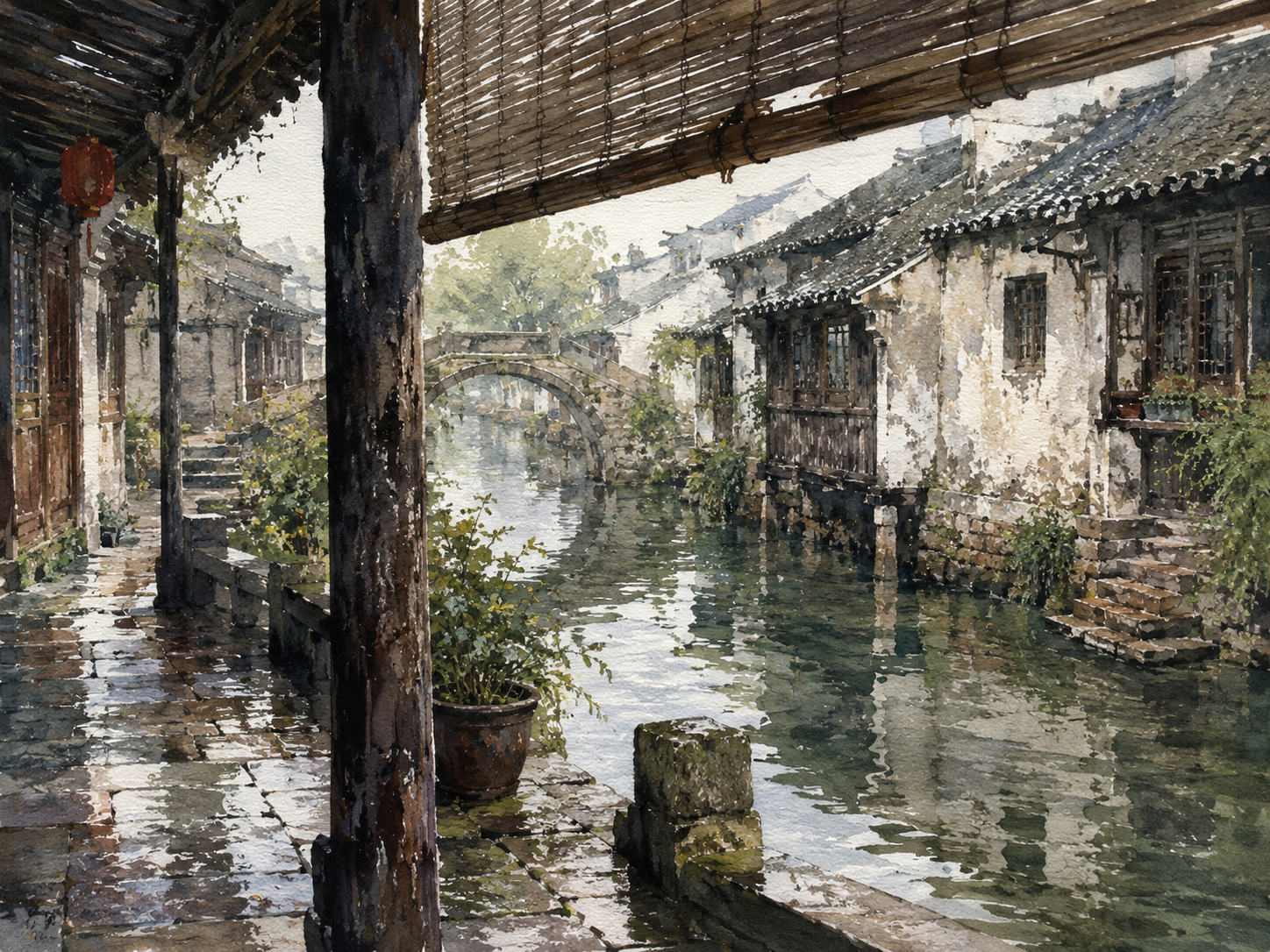
Tranquil Passages of Time
Critique
1. Introduction This watercolor painting offers a detailed and luminous depiction of a canal flowing through a historical Asian water town during the daytime. Viewed from the sheltered vantage point of a covered walkway, the scene captures the intricate relationship between traditional architecture and its aquatic environment. The artwork immediately conveys a sense of calm domesticity and historical richness through its bright, airy atmosphere and meticulous observation of dilapidated but charming structures. 2. Description The composition is anchored on the left by a dark, textured wooden pillar and a tiled roof overhead, with a bamboo blind partially rolled up at the top edge. A wet stone walkway runs alongside the canal, adorned with potted green plants. Across the calm, reflective water, a row of old, whitewashed houses with dark wooden window frames stands directly in the waterway, their walls displaying the mottled textures of age and moisture. In the distance, a classic semicircular stone bridge spans the canal, leading toward lush green trees and hazy, distant buildings under an overcast or softly lit sky. 3. Analysis The artist employs a sophisticated mastery of the watercolor medium to render the complex textures of aging masonry, damp stone, and rotting wood. The perspective is carefully constructed to draw the viewer’s eye along the wet pavement on the left, across the water, and toward the distant bridge, establishing a strong sense of depth. The color palette relies on earthy greens, muted browns, and the varied whites and grays of the buildings, which harmonize perfectly to depict a humid, overcast environment. The reflections in the water are executed with loose, horizontal brushstrokes that break up the solid forms above, adding movement and light to the lower half of the painting. 4. Interpretation and Evaluation The piece can be interpreted as an intimate observation of everyday life persisting within an ancient infrastructure. The prominent wooden pillar and bamboo blind in the foreground serve as framing devices, placing the viewer directly within the scene as a quiet observer. The technical skill displayed in capturing the dampness of the stone and the peeling plaster is exceptional, demonstrating a profound sensitivity to material degradation and natural beauty. The integration of structural rigidity and the fluidity of water is handled with both accuracy and artistic grace. 5. Conclusion What begins as a pleasant view of a canal town reveals a highly accomplished study of texture, perspective, and atmospheric moisture. By placing the viewer in a shaded, specific vantage point, the painting successfully bridges the gap between the observer and the environment, resulting in a tranquil and deeply engaging visual experience.
Same Subcategory
Similar Artworks
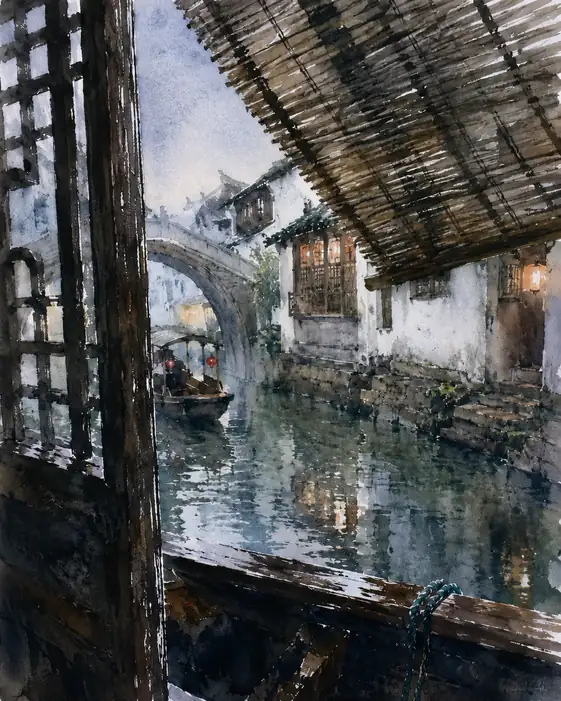 Waiting in the Quiet Dusk
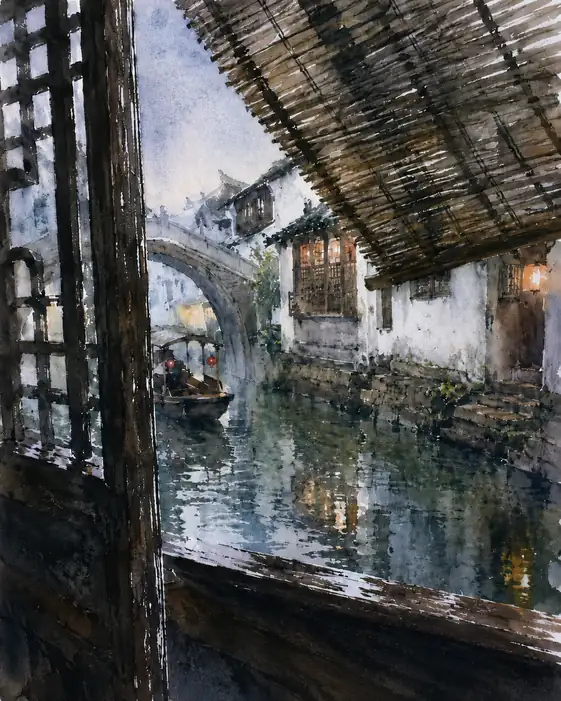 Where the Water Forgets the Time
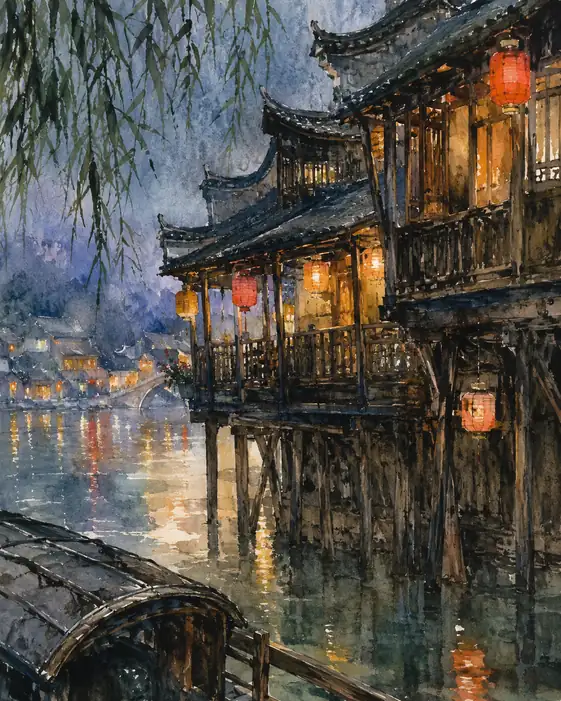 Lantern Whispers on the Water
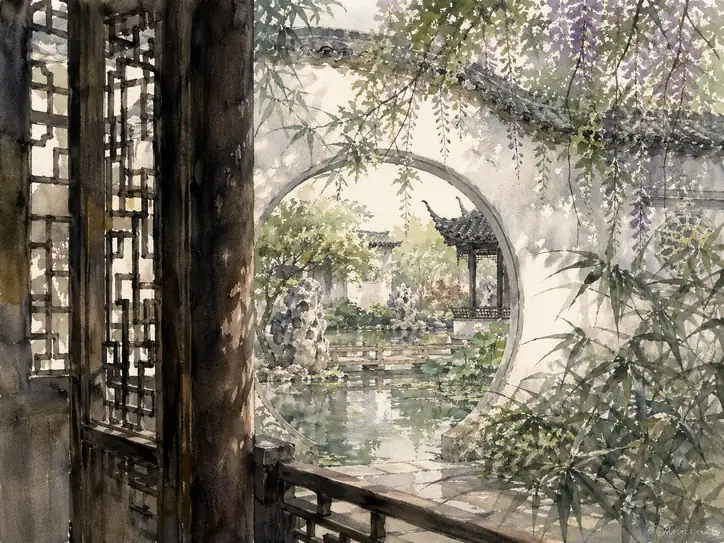 Through the Moon Gate: A Whisper of Serenity
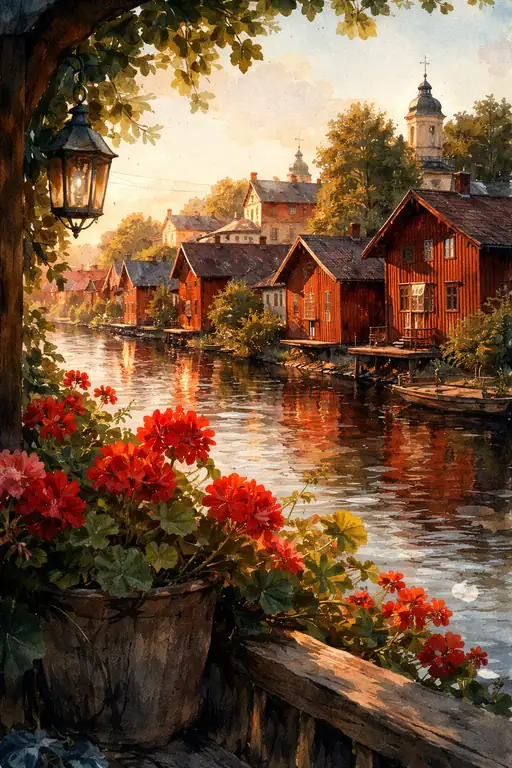 Porvoo Riverside: A Golden Afternoon
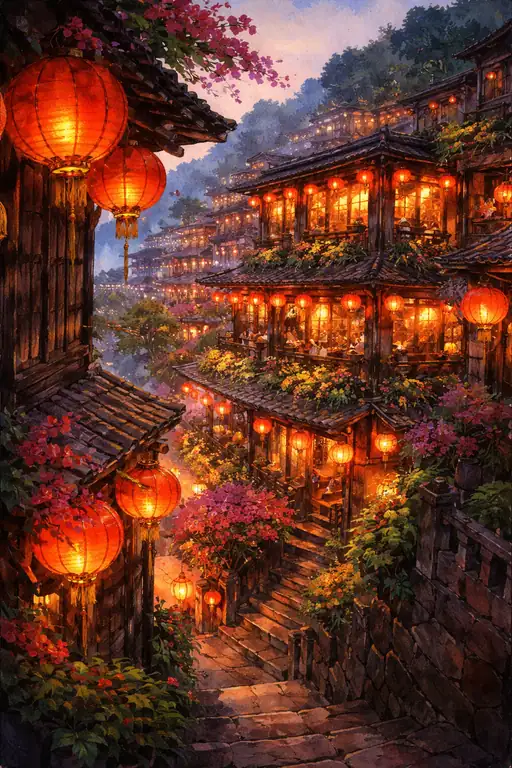 The Festive Glow of the Tiered Village
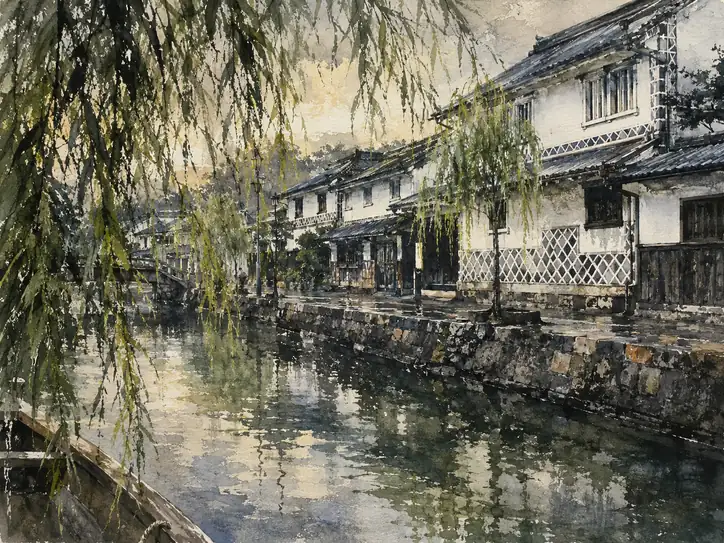 Sigh of the Willow, Mirror of the Ages
 A Dialogue Between Stone and Glass
 Reflections on the Timeless Path
 Tranquility in Bloom: The Lotus Pavilion