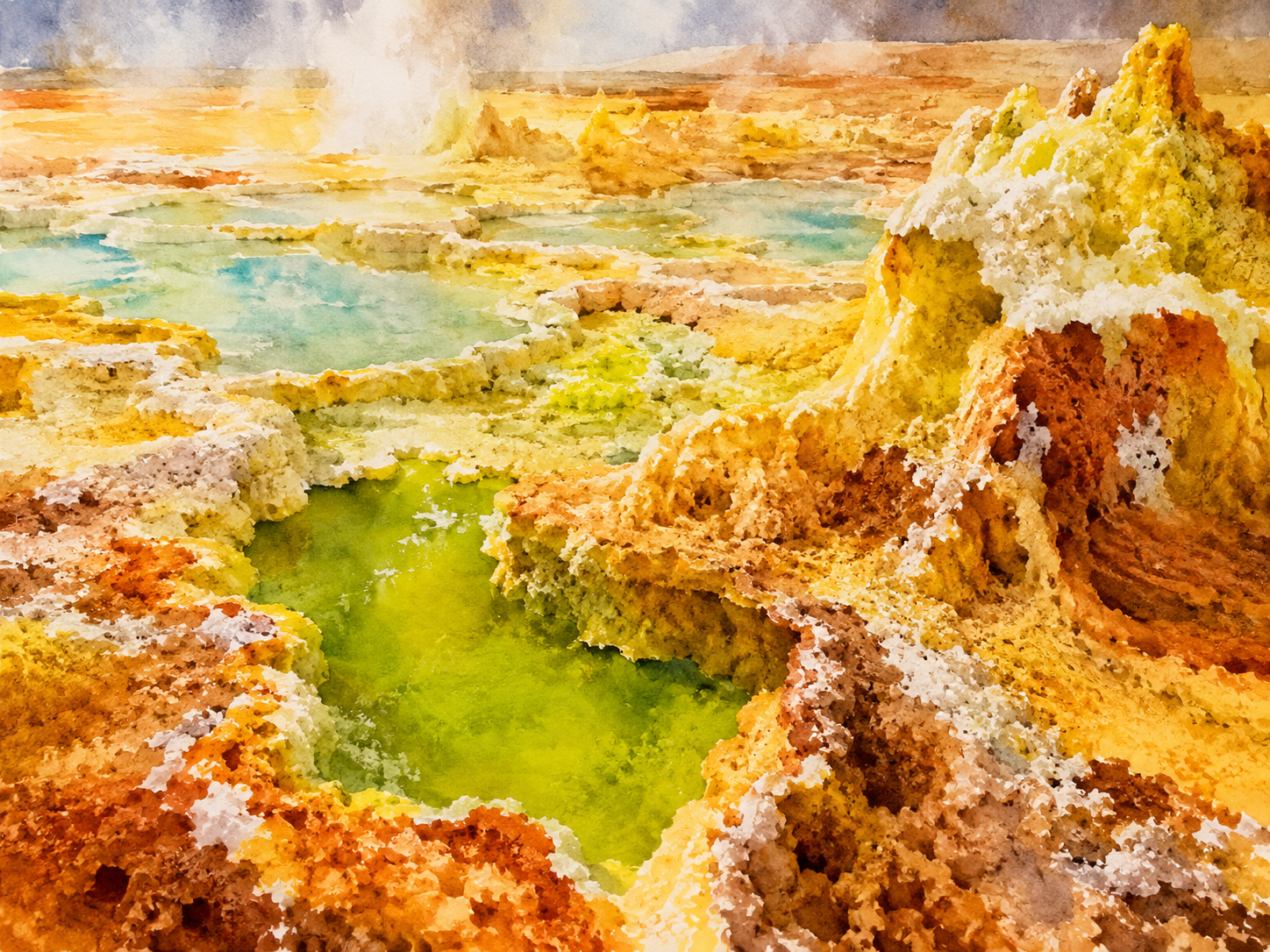
Altar of the Burning Earth
Critique
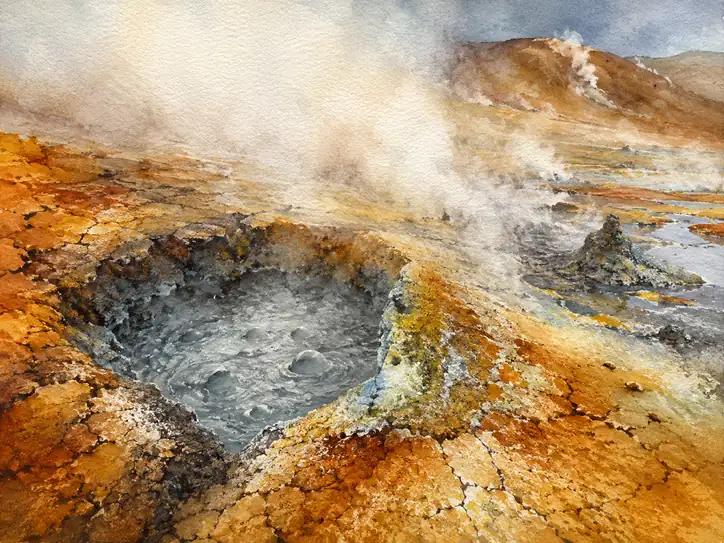
1. Introduction This watercolor painting presents a surreal and alien-like landscape inspired by the hydrothermal fields of a volcanic region. The scene captures the extreme environment where earth, water, and minerals interact to create a vivid tapestry of unnatural colors and jagged geological formations. Through its meticulous rendering, the work invites the viewer to contemplate the primordial forces that shape the planet's most inhospitable yet visually captivating corners. 2. Description The composition is dominated by intricate mineral deposits in shades of sulfurous yellow, burnt orange, and chalky white. In the foreground, a large, crusted formation rises sharply, its porous texture rendered with great detail. Scattered across the mid-ground are several shallow pools filled with strikingly vibrant liquids in neon green and turquoise. In the far distance, plumes of white steam rise from the flat, desolate ground toward a hazy, overcast sky. 3. Analysis The artist utilizes the unique properties of watercolor to mimic the complex textures of salt and mineral crusts, alternating between delicate wet-on-wet washes in the pools and dry-brush techniques for the rugged rocks. The color palette is exceptionally bold, using high-chroma yellows and greens that create a jarring yet fascinating contrast. The asymmetrical composition, with the large formation on the right balancing the series of receding pools on the left, provides a sense of depth and scale. 4. Interpretation and Evaluation This work successfully captures the otherworldly beauty of a geothermal field, translating scientific reality into an aesthetic experience. The level of detail in the mineral structures demonstrates significant technical patience and observation. By focusing on such a specialized and rare landscape, the painting challenges traditional notions of beauty in nature, finding harmony in the chaotic and chemically-charged results of volcanic activity. 5. Conclusion In summary, the painting is a remarkable exploration of texture and color within a specialized geological context. The initial shock of the vibrant, almost fluorescent hues eventually gives way to an appreciation for the intricate organic patterns and the masterful control of the watercolor medium. It stands as a powerful representation of the earth's diverse and often startling creative potential.
Same Subcategory
 Luminous Depths of the Cobalt Spring
 Awakening of the Tropical Giant
Similar Artworks
 The Pulsing Veins of a Primordial World
 Silent Guardian of the Pass
 The Earth's Boiling Breath
 Earth's Breath
 Untamed Vapors: The Primordial Energy of the Volcanic Valley
 Breath of the Living Earth
 Tears of the Earth, Breath of the Sky
 The Earth's Palette
 The Earth's Feverish Breath
 The Eye of Primordial Light