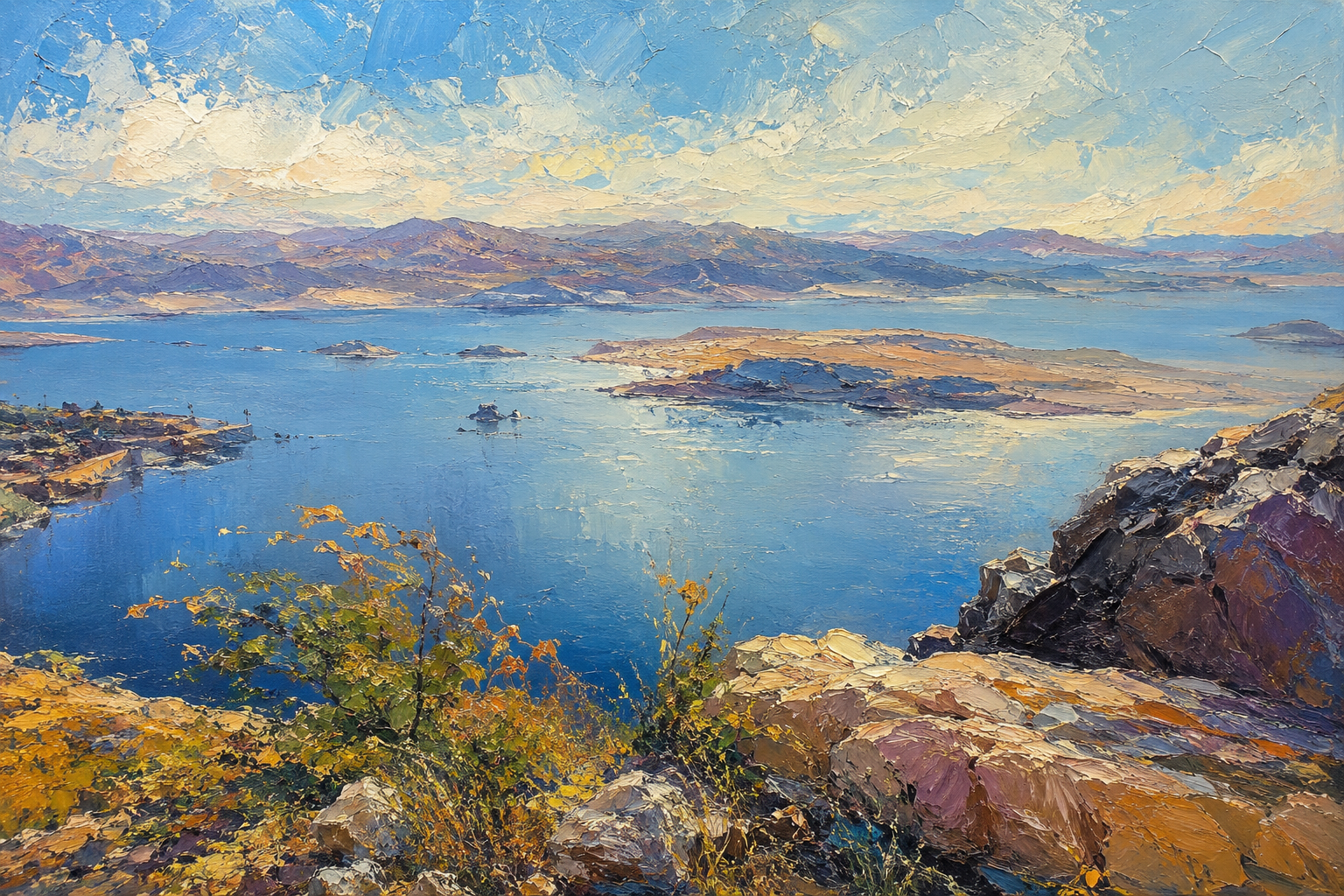
Primal Blue: Majesty of the Desert Lake
Critique
1. Introduction This landscape painting presents a powerful and visceral interpretation of a lake nestled within a rugged mountain range. Utilizing a heavy impasto technique, the artist emphasizes the physical presence of the environment, transforming a traditional scenic view into a tactile exploration of form and color. The composition captures the raw, untamed beauty of the wilderness, inviting the viewer to experience the grandeur of nature through the expressive materiality of the paint itself. 2. Description The foreground is defined by jagged, heavily textured rock formations and scattered shrubs with autumn foliage, rendered in thick strokes of ochre, sienna, and deep violet. In the middle ground, a vast expanse of deep blue water stretches across the frame, its surface reflecting the bright sky and dotted with several small, rocky islands. The background features a succession of rolling mountain peaks in shades of lavender and muted brown, which gradually fade into a dynamic sky filled with broad, sweeping clouds of white and pale yellow. The entire surface of the canvas is characterized by a rich, sculptural quality that reveals the energetic movements of the artist's tools. 3. Analysis The work is a masterful study in the contrast between warm and cool tones, which effectively establishes a strong sense of depth and atmospheric perspective. The vibrant yellows and oranges in the foreground pop against the cool blues and purples of the distance, pulling the observer's eye through the expansive landscape. Technically, the artist's reliance on a palette knife or a heavily loaded brush creates a mosaic-like surface where each individual stroke retains its own identity while contributing to the whole. The light appears to catch on the physical ridges of the paint, adding a real-world dimension of shadow and highlights that shifts as the viewer moves, further enhancing the painting's dynamic quality. 4. Interpretation and Evaluation This painting successfully conveys the enduring strength and permanence of the geological landscape. The deliberate choice to use such thick, unblended colors suggests a rejection of delicate realism in favor of a more emotional and sensory representation of the world. From an evaluative standpoint, the work is highly successful in its ability to balance chaotic, energetic mark-making with a clear, coherent spatial arrangement. The artist's confident handling of the medium demonstrates a sophisticated understanding of how texture can be used to evoke the solidity of stone and the fluidity of water, resulting in a piece that feels both grounded and transcendental. 5. Conclusion The painting stands as a bold and evocative celebration of the natural world, achieved through a remarkable command of the impasto technique. Its strength lies in its ability to communicate the silent majesty of the mountains and the serenity of the water through a highly active and expressive surface. While the initial impression is one of intense color and texture, a closer study reveals a carefully structured composition that honors the logic of the landscape. Ultimately, the work offers a transformative vision of nature, demonstrating that the physical act of painting can be as powerful as the subject it depicts.
Same Subcategory
 The Stillness of Crystal Waters
Similar Artworks
 Serenade of the Heather and the Lake
 The Breath of Ocean and Stone
 Where the Morning Sun First Speaks
 Celestial Intersection
 Vibrating Light Beneath the Majestic Peaks
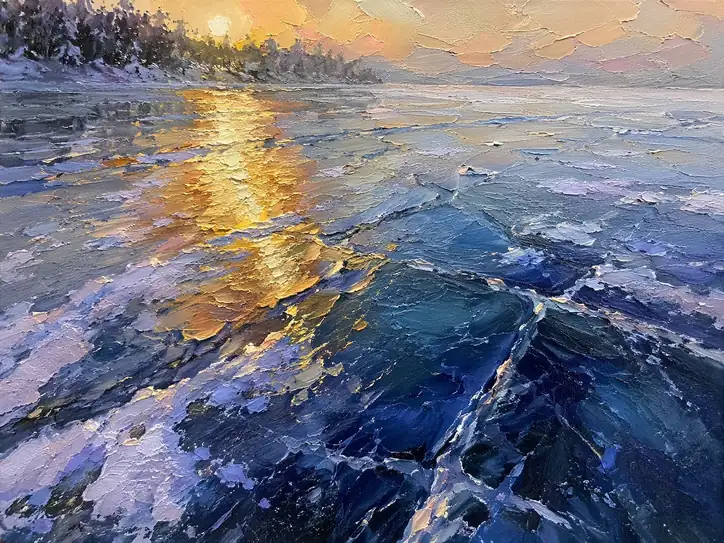 The Golden Hour Thaw: A Textured Solitude
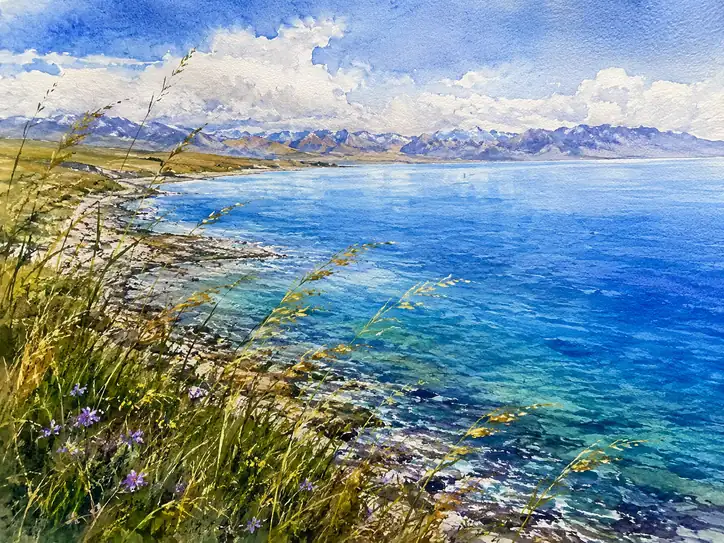 A Song of the Clear Blue
 Silent Vigil on the Rocky Ledge
 The Mountain's Eternal Reflection
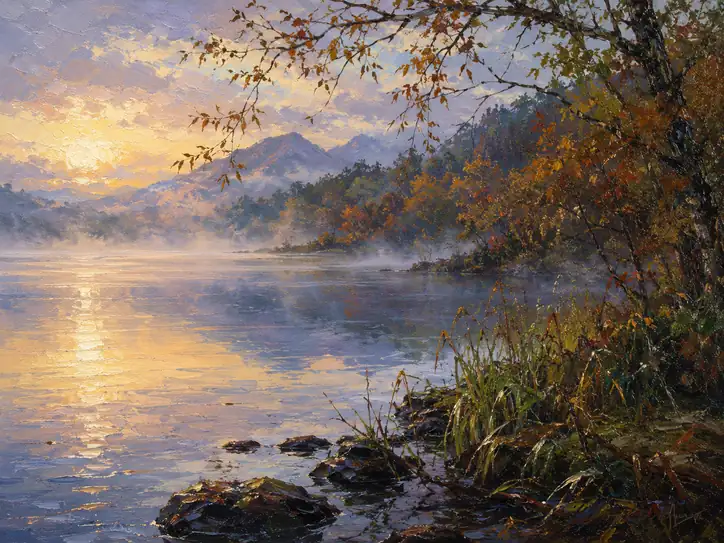 Solitude by the Fog-Bound Pond