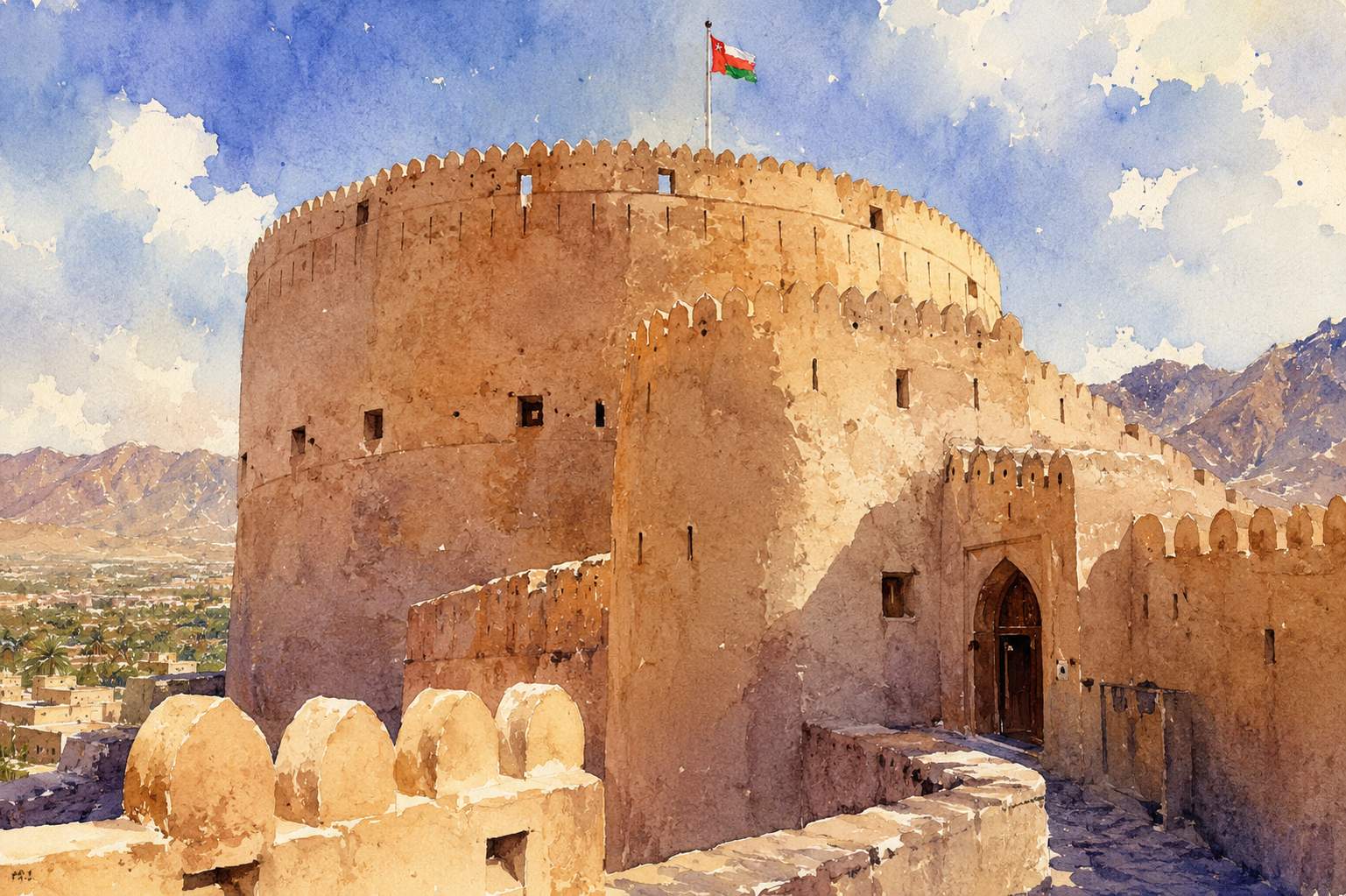
Bastion of the Golden Horizon
Critique
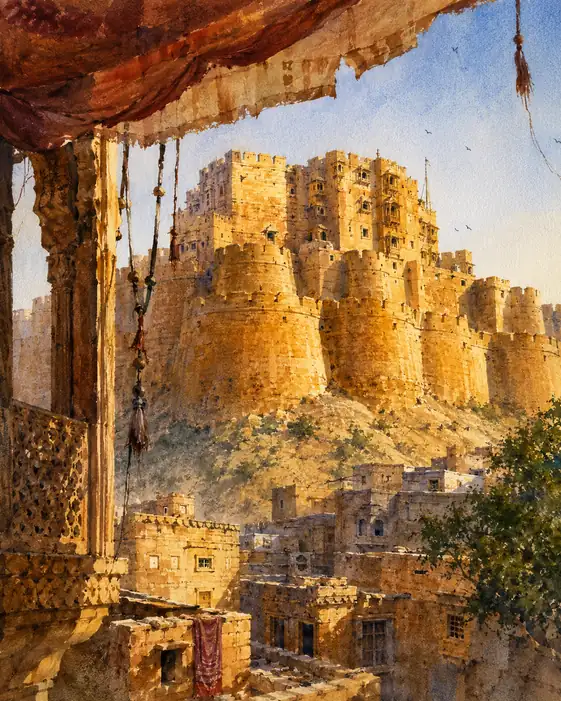
1. Introduction This watercolor painting presents a monumental view of a traditional desert fortress, capturing the rugged grandeur of historical Middle Eastern military architecture. The work focuses on a massive circular tower that stands as a testament to regional defensive strategies and craftsmanship. Set against a backdrop of distant mountains and a lush oasis, the scene evokes a sense of enduring strength and historical continuity. 2. Description The central feature is a towering, cylindrical structure made of sun-bleached stone, topped with distinct crenellations and a small flag fluttering against the sky. To the right, an arched entrance leads into the fort's interior, while the foreground is occupied by a lower, zigzagging defensive wall. In the background, a jagged mountain range rises above a verdant valley filled with palm trees and scattered traditional dwellings, providing a geographic context for the fortification. 3. Analysis The artist employs a sophisticated use of watercolor to render the weathered textures of the stone walls, using subtle washes of ochre and tan to suggest the effects of sun and wind. The vibrant blue of the sky creates a sharp contrast with the warm tones of the fort, enhancing its monumental presence. Linear perspective is effectively used in the foreground walls to create depth, while the distant mountains are rendered with softer edges to indicate atmospheric perspective. 4. Interpretation and Evaluation This work is highly successful in its technical execution, particularly in the detailed depiction of the fort's complex geometry and defensive features. The composition is dynamic, using the diagonal lines of the walls to lead the viewer's eye through the space. By positioning the fort above the oasis and against the mountains, the painting highlights the strategic importance of the structure and its integration with the natural landscape, offering a respectful tribute to regional heritage. 5. Conclusion Initially, the massive scale of the circular tower commands attention, but further inspection reveals the intricate textures and the relationship between the fort and its surroundings. The contrast between the solid, man-made fortress and the soft, organic forms of the valley below creates a compelling visual dialogue. Ultimately, the painting serves as a powerful evocative study of architectural heritage, capturing both the physical presence and the silent history of the desert stronghold.
Same Subcategory
 Eternal Sentinel of the Crashing Tide
Similar Artworks
 The Secret Jewel of the Canyon
 Golden Echoes of an Ancient Kingdom
 Whispers of Zubarah's Sands
 Guardian of the Sun-Kissed Earth
 The Sentinel of the Sands
 The Fortress of Eternal Dreams
 Eternal Watcher of the Sands
 Golden Echoes of the Stone Sentinel
 Eternal Stones, Dancing Petals
 Bastion of Eternal Silence