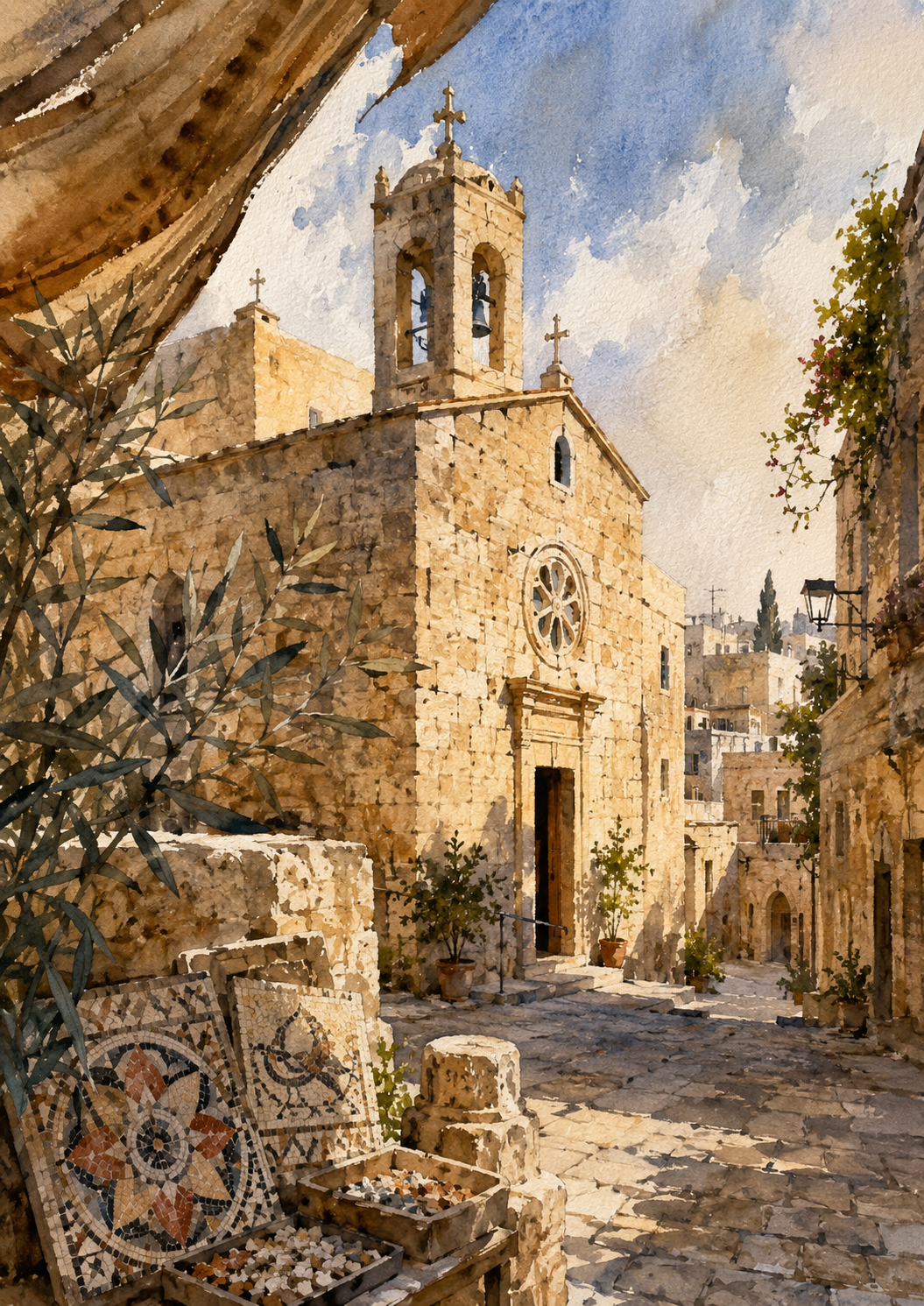
Where Sunlight Lingers on Ancient Prayers
Critique
1. Introduction This watercolor painting depicts a sun-drenched scene of an ancient stone church nestled within a Mediterranean-style village. The composition effectively balances the imposing verticality of the church's bell tower with the intimate details of a roadside mosaic stall in the foreground. Through a palette dominated by warm earth tones and brilliant highlights, the artist captures the intense luminosity of a bright, clear day. The work reflects a harmonious intersection of historical architecture, local craftsmanship, and natural vegetation, presented with technical proficiency and atmospheric sensitivity. 2. Description The central focus of the artwork is a multi-story stone church featuring a prominent bell tower with two visible bells and a decorative rose window above the main entrance. The church is constructed from rough-hewn, light-colored blocks that reflect the strong sunlight, casting sharp shadows on the cobblestone street. In the lower left foreground, several mosaic panels with geometric and figurative designs are displayed alongside wooden boxes filled with small, colorful stones. To the right, a narrow alleyway recedes into the background, where more stone buildings and a single cypress tree are visible under a bright blue sky with wispy clouds. 3. Analysis The artist employs a dynamic range of values to create a strong sense of three-dimensional form and sunlight. The use of high-contrast shadows defines the texture of the stone walls and the intricate details of the church's architecture. A warm color scheme of ochre, sienna, and cream is punctuated by the cool blue of the sky and the dark greens of the foliage, creating a balanced and naturalistic atmosphere. The brushwork is particularly effective in the foreground, where quick, decisive strokes represent the leaves and the textural variety of the mosaic fragments and cobblestones. 4. Interpretation and Evaluation The painting successfully conveys a sense of timelessness and cultural heritage through its careful attention to architectural and artisanal details. The inclusion of the mosaic stall in the foreground adds a human dimension to the scene, suggesting a living connection between the ancient stones of the church and modern local traditions. Technically, the control of light is impressive, as the artist manages to depict a very bright scene without losing detail in the highlights. The composition is well-structured, using the branches on the left and the buildings on the right as framing elements that draw the viewer's eye toward the central church. 5. Conclusion What initially appears as a straightforward architectural study reveals itself to be a nuanced exploration of light and local identity upon further inspection. The artist’s ability to render the heat and brilliance of the Mediterranean sun through the watercolor medium is exceptional. Ultimately, the piece stands as a compelling tribute to the enduring beauty of traditional stone architecture and the quiet, sun-lit moments of village life.
Same Subcategory
 Stones That Remember the Light
Similar Artworks
 Under the Vineyard's Watch
 A Mediterranean Summer Song
 Whispers of the Sun: A Timeless Midday
 A Winding Path Through History
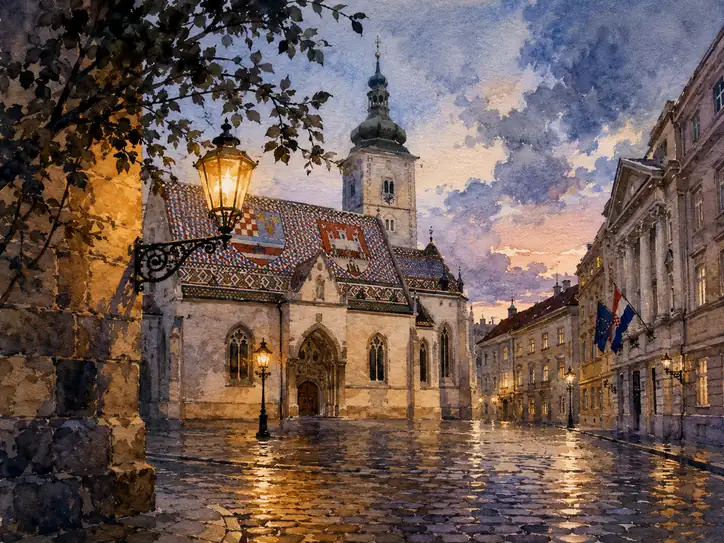 Golden Whispers of a Rainy Evening
 The Sunlit Silence of Yesterday
 Whispers of Sunlight Through the Stone Arch
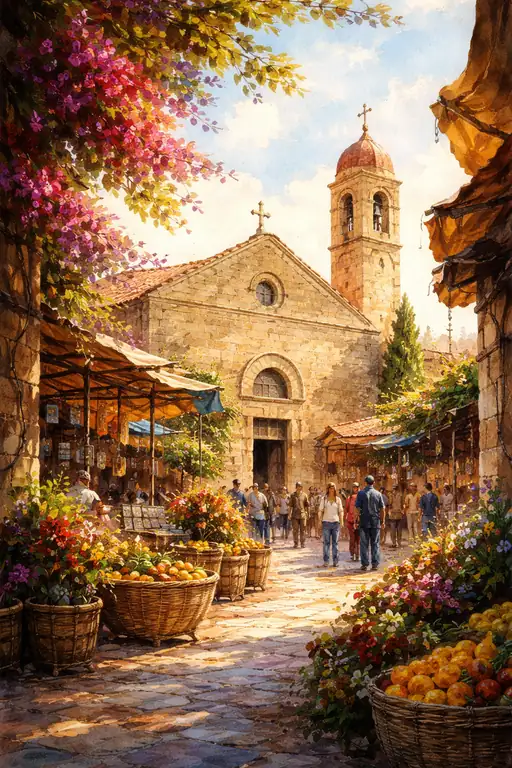 Bustling Marketplace Beside an Old Stone Church
 Golden Embrace of the Colonial Crown
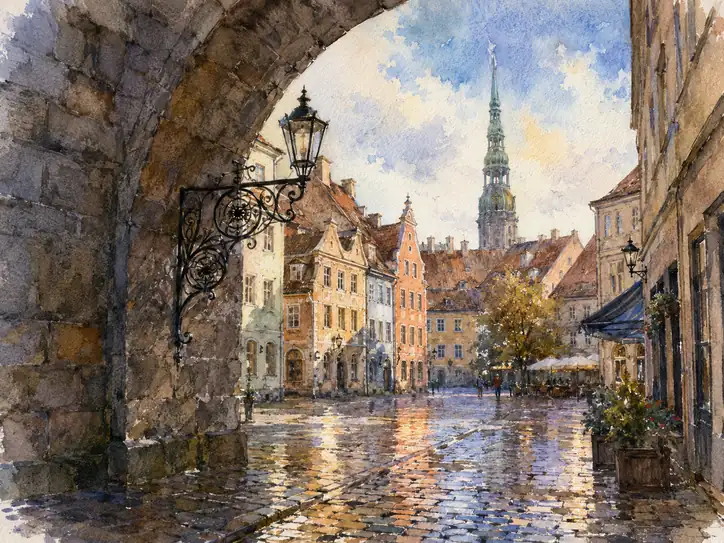 Glistening Rain in the Eternal City